
1.7 Maps
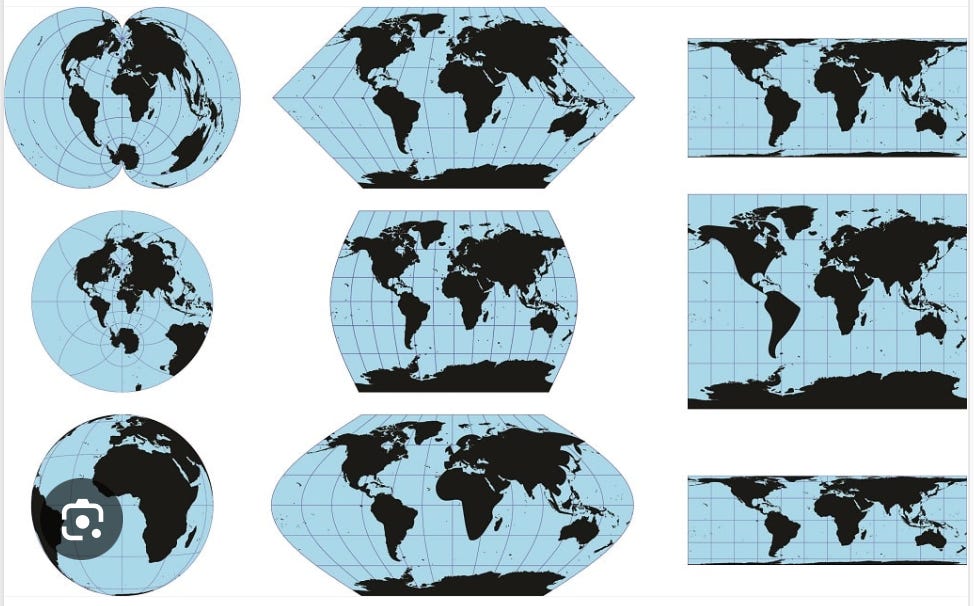
It is said that one of our most basic needs is to orient ourselves in the world. The evolutionary purpose of this is deep and strong: it helps us remember where to find food, kin, and shelter. Fast forward several millennia and a few stages of development. We still need maps to help us know where we are, but today the maps include those that orient us to ideas as well as locations. Sit down to pay the bills and we pull up our math and accounting maps to navigate the process. Read a novel and we use our language and metaphorical maps to make sense of the story. When we are new to a subject, we learn a new map to guide us. After we’ve mastered the territory, the map resides stably in our brains and we use it unaware of doing so.
A map is a tool that takes a piece of territory and simplifies it. Technology has increased the flexibility of maps so that we can zoom in to see the territory in more detail with more types (called layers) of information available to the user. We can zoom out from the trees, when we want to see bigger patterns, like the forest. There is never a one-to-one correlation between a map and the territory, but mapping technology now gives us the ability to get closer to the level of detail we want. We are always “tuning” for resolution and types of information, looking for the sweet spot Einstein referred to when he said “Everything must be made as simple as possible. But not simpler.”
Example of an Integral Map
Here is an Integral map that illustrates both Quadrants and Levels. The Quadrants are the four corner boxes and examples of developmental models are shown in the respective quadrants.
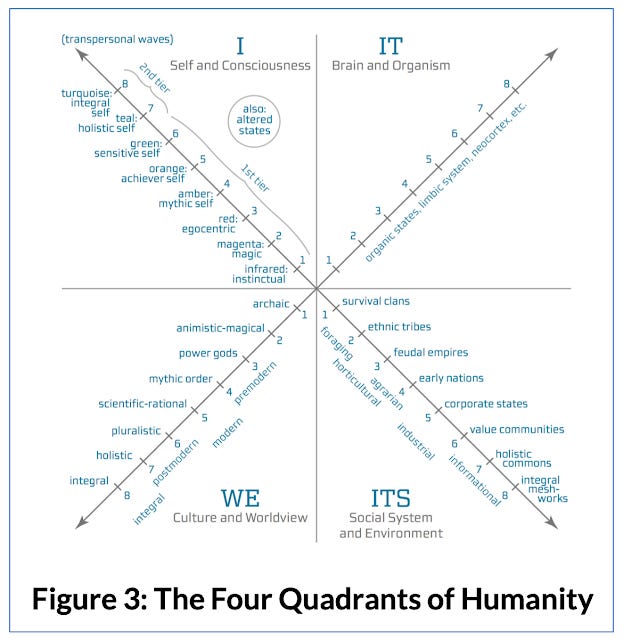
[Image from Integrallife.com]
Other maps and visual representations will be used in these discussions, but that is enough for now.
I will speak often of maps. Other metaphors that sometimes pop up when I’m thinking about Integral are scaffolding, architecture, lenses, filters. These words suggest a framework to the structure and perspectives that Integral provides to our current worldview. The concept of orienting continues to work whenever we are using the various forms of maps: a means of helping us know where we are. Plus, as the word “Integral” implies, it includes everything: my inner world, my philosophy and spiritual life, my communal life with my wife, family, friends, church, city, and neighborhood. It also includes science and seeing the systems that form our world, both natural and human made.
When I speak of maps, I’m referring to these points of reference that give the world an overarching order. This contrasts sharply with my “pre-Integral” worldview: people, ideas, beliefs, and institutions as “bumper cars,” randomly bouncing off each other with no sense of order, like knowing about the states in the US, but having no awareness of their location. Knowing the geography is still complicated, but it makes a lot more sense! (updated 5-22-23)