
2.10.a Including Green
This will be the last of the series of Including Red, Including Blue…. We do have one more level to discuss—Yellow—but for now that will conclude our review of the Five Central Spiral Dynamics Stages.
Here are my suggestions on some Green traits we can carry forward or include: Everybody is equal; Learn to collaborate; Accepting of others; pluralistic views; Renewal of spirituality; environmentally sensitive.
Great, you’re getting the swing of this thinking. It is also interesting to think about the traits you passed over.
Don’t read too much into that, but I admit there are some Green ideas I think might be pushed too hard or too far. I realize those are traits I might be more resistant to.
Good thought. Remember what we said about the Buddha’s Middle Way in 2.8.a, and Aristotle’s Golden Mean warns us that a strength taken to an extreme can morph into a flaw. Applying these moderating considerations, let’s look at your list of “keepers” or “includers.”
Everybody is equal. Generalizing equality to every factor eliminates the opportunity for people to shine in their own areas of excellence, be it math, humor, science, music, technology, spirituality, et cetera. In committees and teams, it is good to identify and recruit people with special skills to cover a wider range of perspectives.
Learn to collaborate. Agreed, and it can help a lot to decide beforehand how our group is going to decide. Consensus often is linked to collaboration, and that particular form of collaboration leads to one of the major shortcomings of Green processes: endless discussion. It helps to identify backup decision processes like majority rules or leader deciding after consultation.
Accepting of others; pluralistic views. How do we deal with others whose views or morals lie beyond the pale? (See below.)
Renewal of spirituality; environmentally sensitive. We will talk about this in the future, and it is very important because as Einstein said: “science without religion is lame, religion without science is blind.” The perspective I will add is that our view of religion is another human endeavor that is developmental and those of us who could not abide the literal and mythic interpretations held by so many mainstream churches do have an alternative. Surprised? Stay tuned.
Let’s think a little more about accepting others. Greens are good at accepting minorities and disadvantaged groups. Many Greens are hampered by an inability to accept the difficult behaviors and views of those at earlier stages, the folks who are not yet able to accept minorities and the disadvantaged.
And that gets us back into the problem of accepting values we don’t accept!
OK, but here are two things to consider.
First, remember that each stage is necessary! If we can accept that, it can be easier to accept that people at earlier stages are primarily motivated by the need for safety, security, and belonging.
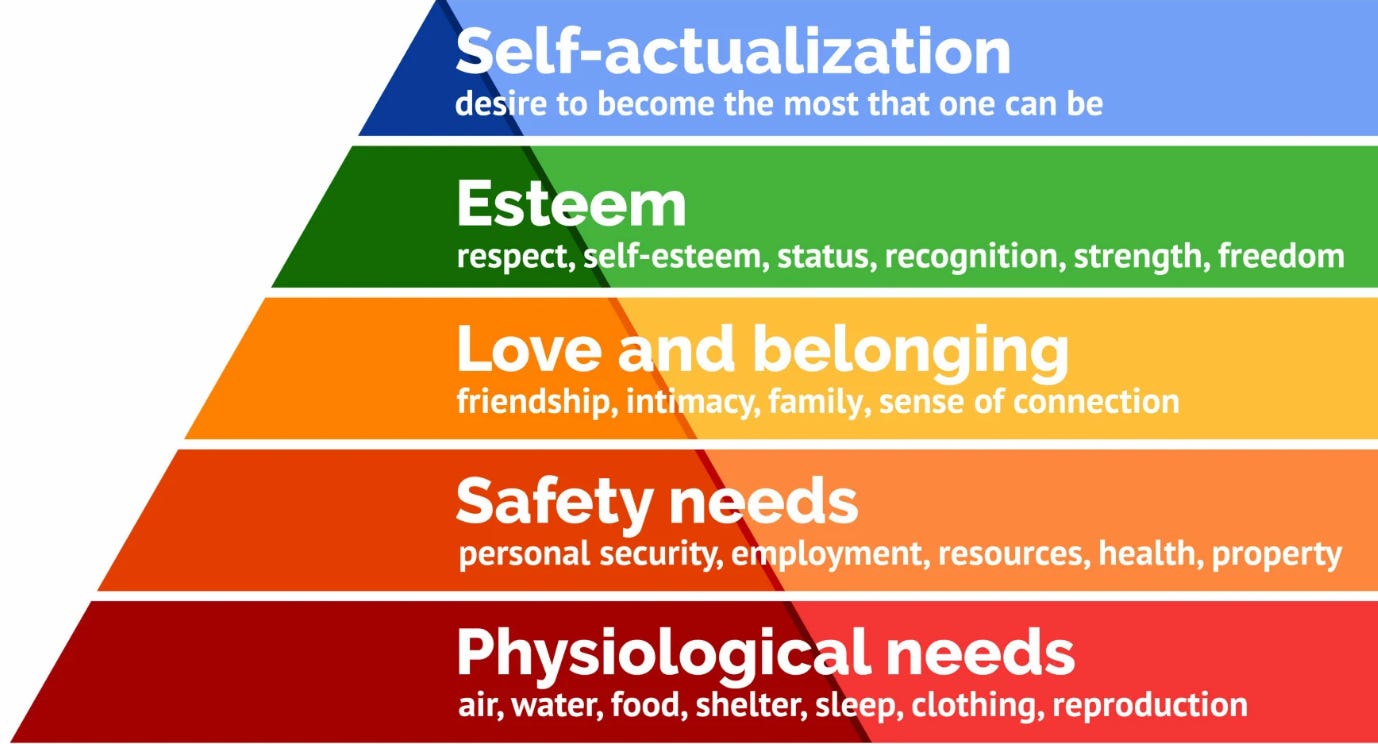
Maslow’s hierarch of needs reminds us that physical and safety needs are foundational and require large outlays of energy and time. For now, just consider that those we criticize for being fearful are struggling with these basic levels!
Just saying this to myself makes me realize how much I have in common with them.
Second, Accept is not the best choice of words; Wilber’s instruction is that we Include. It reminds me of the phrase “everything belongs,” which also sounds a little shady. But if we think of the developmental process as a sequence of “mid-course corrections” to keep us on track to our goal, we are taking stock of our current status—good or bad—and correcting, correcting, correcting. All our navigational measurements—including the bad news—belong in our calculations, otherwise our adjustments will take us even further off course! We don’t have to accept to include!
In Saving Us, A Climate Scientist’s Case for Hope and Healing in a Divided World, Katharine Hayhoe tells the story, after a talk she gave in Texas, about a farmer, shaking his head, said to her “everything you said makes sense, and I’d like to agree with you. But if I agree with you, I have to agree with Al Gore, and I could never do that.”
Now, don’t shake your head! Remember the Wilber perspective:
“Everybody is right. More specifically, everybody — including me — has some important pieces of truth, and all of those pieces need to be honored, cherished, and included in a more gracious, spacious, and compassionate embrace.”
If we are undeniably interconnected, a basic tenet of Green, our “inner work” includes including the existence of other perspectives without accepting them.