
2.15.1 Stages = Grades
Now, let’s look at all five of these Core stages of Spiral Dynamics together. In several of his books, Ken Wilber frequently uses the conveyor belt metaphor to describe our progress through the stages of development. We move along the conveyor belt from station to station, getting off at each one to do the work and complete the developmental tasks of each stage.
In Finding Radical Wholeness, Wilber’s latest book, he introduces a new metaphor. His topic is spiritual development, and he describes a “spiritual curriculum” that could be rolled out over a lifetime. While he still refers to the conveyor belt metaphor, here he uses a “school-grade” model to describe the span of development. Religious activities like education, sermons, music, and such would be developmentally designed to make sense to people's worldviews at different levels. He suggests a curriculum for magic, mythic, rational, pluralistic, and integral Christianity1. As children, adolescents, or adults mature, they may find that certain beliefs become unbelievable. However, in an Integral church, a new worldview is available. These recalibrations would happen during each of the stage transitions listed. In his book Integral Christianity: The Spirit’s Call to Evolve, Paul Smith articulates such a vision.
Are you suggesting this spiritual curriculum model could be used in other walks of life?
Absolutely! Take a look at the chart below. Without any intentional prompting or self-awareness of development, people grow through the five general stages I use in this Glimpsing Integral Substack.
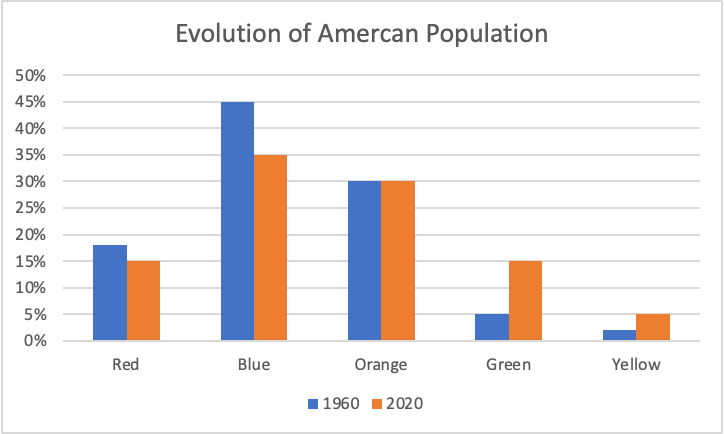
I want to make four points about the chart:
An individual might find themselves at any stage and have the potential to grow all the way to yellow in their lifetime.
In 1960, over 60% of the population was Traditional or earlier (Red or Blue, the impulsive rebellious or orderly authoritarian stages). The green, postmodern stage was barely even showing up at that time2.
About 50% of the population is still traditional, or earlier, while the percentage of postmoderns has at least tripled. In general, the center of gravity of the population has become slightly more mature, but “the mass of the average” ensures this progress will be agonizingly slow.
Individuals develop; Cultures evolve3. Once an individual has passed stage 2 into stage 3, regressing to stage 2 is unusual. Even if a million people evolve to stage 3, about a million new people will replace them, leading to little overall cultural change. There will always be less developed members of our culture. And at present, we are dominated by leaders who operate primarily within a binary, either/or worldview. Reaching a critical mass of individuals at the Tier 2 Yellow stage will give our culture the leadership necessary for creating and running a society based on a balance of non-dual and dualistic worldviews and technologies. (Wilber suggests we need about 10% at Tier 2 stages for this balanced worldview to gain traction.)
If I’m getting the gist of this, we have the red, blue, orange, green, and yellow grades of life. Right?
Yep. Here are some more thoughts about this “life school”:
This is not a seniority system. You do not advance to the next level based on age. Growth occurs as we complete the developmental tasks of each level.
Since growth is hard, humans can be reluctant to do the hard work. Erik Erikson identified eight stages of developmental tasks. Suzanne Cook Greuter identified nine stages of ego development. Robert Kegan identified five stages of unfolding consciousness. The five stages in my model above slice the sequence differently, but the trend of increasing capability to respond to increasing complexity is consistent across theories.
There is an ongoing supply—based on preceding birth rates—of new Reds feeding the pipeline from the left, earlier levels. So, we will always have some of our population in the early stages.
It takes time to grow, so it is natural that more people occupy the left side of the chart. One benefit of our longer lifespan is that we have more time to complete the developmental tasks to grow to later stages. That increases our collective development, although slowly.
Individuals can grow through the entire sequence in their lifetime. Cultures are always “held back” by the gravitational pull of the earlier stages. Despite that, cultural growth has been increasing. For example, few nations had outlawed slavery in the 1700s; by 1900, few nations still legally allowed it.
Why isn’t this a seniority system? Why can’t we just put in our time and have personal growth occur?
This is a simplistic answer, but think of it like this. Let’s say as a kid, I liked to build model rockets. Then I graduated to hobby rockets that launch and fly. Would that, plus a few more years, qualify me to work for NASA, or would I have to go to college to learn to be a “rocket scientist?” Wouldn’t I have to do some intensely difficult work to be qualified?
There are rocket science equivalents in parenting, managing money, being a good friend, neighbor, and citizen, deepening religious awareness, and communicating effectively. You might not need intense study to do these things, but they don’t come without attention, time, and effort.
One more question. What about the person who stops moving along the “grades?” What’s going on there?
Here’s one way to think about that. As a teenager, you are a good student in school, first chair in the school band, and an athlete drawing attention from college scouts. At some point, most people will focus on one area and either drop or reduce their involvement in the other areas.
These are three distinct Lines of Development of human capability. I go into more detail in the posts about Lines, which cover capabilities like athletics, music, cognitive achievement, emotions, ego, spirituality, and so on. Humans follow their talents and interests, achieving poor, average, excellent, and mastery-level skills.
So, we make choices about where we put our attention and effort. Even if we do not grow to a very mature level in the chart above, there might be a Line along which we have devoted much effort. We might not be happy with this decision, but it is one explanation.
Other explanations include:
Comfort-rich environment. We don’t have many challenges, so we don’t put in the effort to excel in any area.
Excessive fear or anxiety. We are expending all of our attention on survival and cannot focus on personal development.
There is no support for experimentation. Our community discourages us from exploring the world and experimenting.
Poverty, poor health, injury, or unresolved trauma. We don’t have the personal resources to do the work to grow.
Notice that this discussion relies on three of the Rules of Development:
Growth occurs in a logical sequence of stages or expanding world views from birth throughout adulthood.
Later stages are reached only by journeying through the earlier stages. To get from A to C, you have to go through B.
A person who has reached a later stage can understand earlier world views, but a person at an earlier stage cannot understand later ones.
What if I don’t accept these rules?
Well then, you have to look somewhere else for the answers to life, the universe, and everything ;) But seriously, don’t just “not accept them.” Figure out what your questions are, and please ask.
These are the stages of Cultural Development outlined by French developmental theorist Jean Gebser.
When people complain that cultural, religious, and political leaders of 1960 were morally bankrupt, we might consider that that was the water they were swimming in. History is not static; they did not know what we now know. And if we think we now know what future humans will know, well….
“Individuals develop; cultures evolve.” This might be a stolen quote, but I can’t find the source. It captures the relative speed of individual development compared to collective development. It also reflects that individuals develop in response to their circumstances, while cultures evolve as their changes find the adaptations most beneficial to the collective.