
2.2 The “Rules” of Development
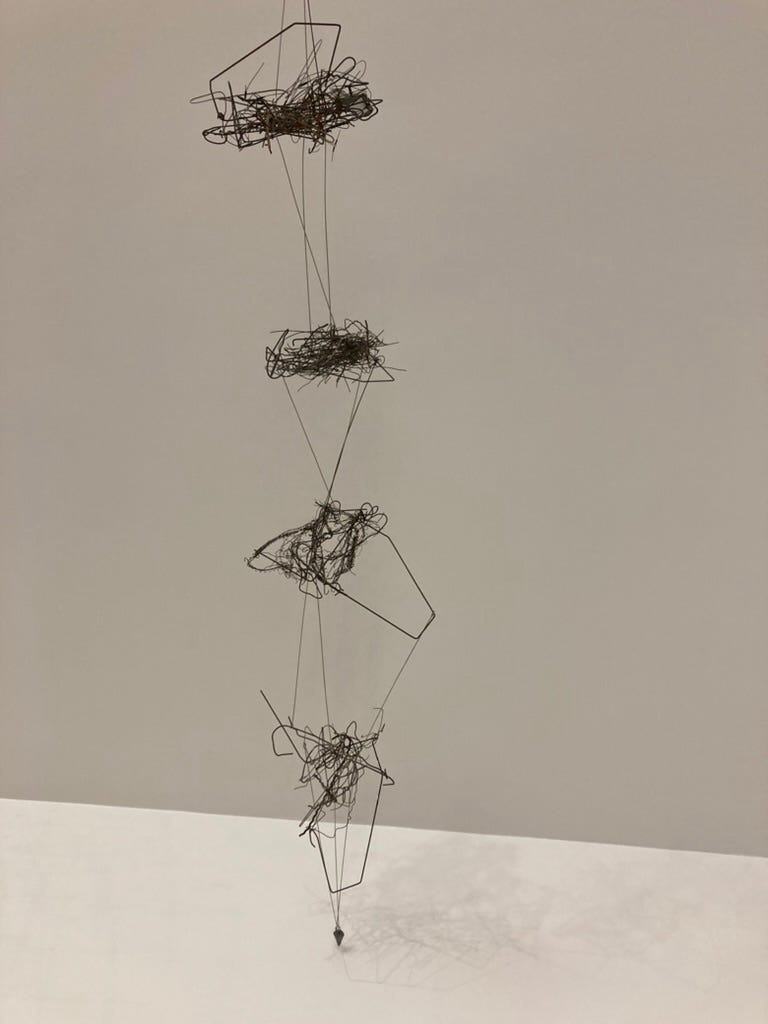
Susanne Cook-Greuter lists 11 tenets in her defining article about Ego Development Theory.1 I prefer the more informal term, “rules,” but these tenets (think tendencies or trends) are a kind of glue that describes how the stages of developmental theories interact. Development theories are not rigid like stairways or ladders with distinct steps or rungs. The stages are more like “probability clouds”2 of common traits that form a “center of gravity” at each stage level. The image above is a nice rendering of what these inexact clusters representing stages might look like. These first 3 rules capture the following central theme of development theories:
Development theories describe sequential growth in response to changes in circumstances: the environment, cognitive skills, social environment and skills, emotional and physical health, and spiritual experiences and understanding. This growth both builds upon earlier growth, and transcends it.
Development theory describes the unfolding of human potential towards deeper understanding, wisdom and effectiveness in the world. We have the potential, barring accident, disease or severe hardship, to grow in our effectiveness, thinking abilities, and wisdom. Brain "plasticity” continues throughout our lives. Several psycho-social developmental stages are available to us throughout adulthood.
Growth occurs in a logical sequence of stages or expanding world views from birth through adulthood. The sequence requires mastery, or at least competence at each stage before one can go to the next. A foundation for the next stage has to be established. But there also has to be a need to grow. We may discover our current worldview, understanding, and skills no longer are adequate to our life conditions. There is an organic logic in the sequence of stages, just like in the example: Letter > Word > Sentence > Paragraph. You can’t skip stages; you can't skip from letters to sentences without learning words. Each stage is dependent on the earlier stages.
Overall, world views evolve from simple to complex, from static to dynamic. You will see this pattern over and over as we look at development models. Look at the Letter to Paragraph example. Individual letters are static. Words become more dynamic as different combinations of letters or different ordering of the same letters can lead to words with different meanings. Sentences of words in different orders, or with different punctuation marks can change meaning. Each of these stages increases our ability to express increasing levels of subtlety and complexity.
But…well…so what? Why does this matter?
I think it matters as a statement about how development models work. Development is an evolutionary process, but it also takes place within the context of a lifetime. Systems, organisms, or people evolve when their world requires more complex responses. An individual, as he or she grows up usually comes into contact with more complex and challenging circumstances. If they are protected from new situations, if they control their environment by their choice of friends, who they marry, their church or occupation, they might end up avoiding the need to adapt and grow very much. On the other hand, if they venture out and are exposed to new experience, they must evolve to meet more complex challenges.
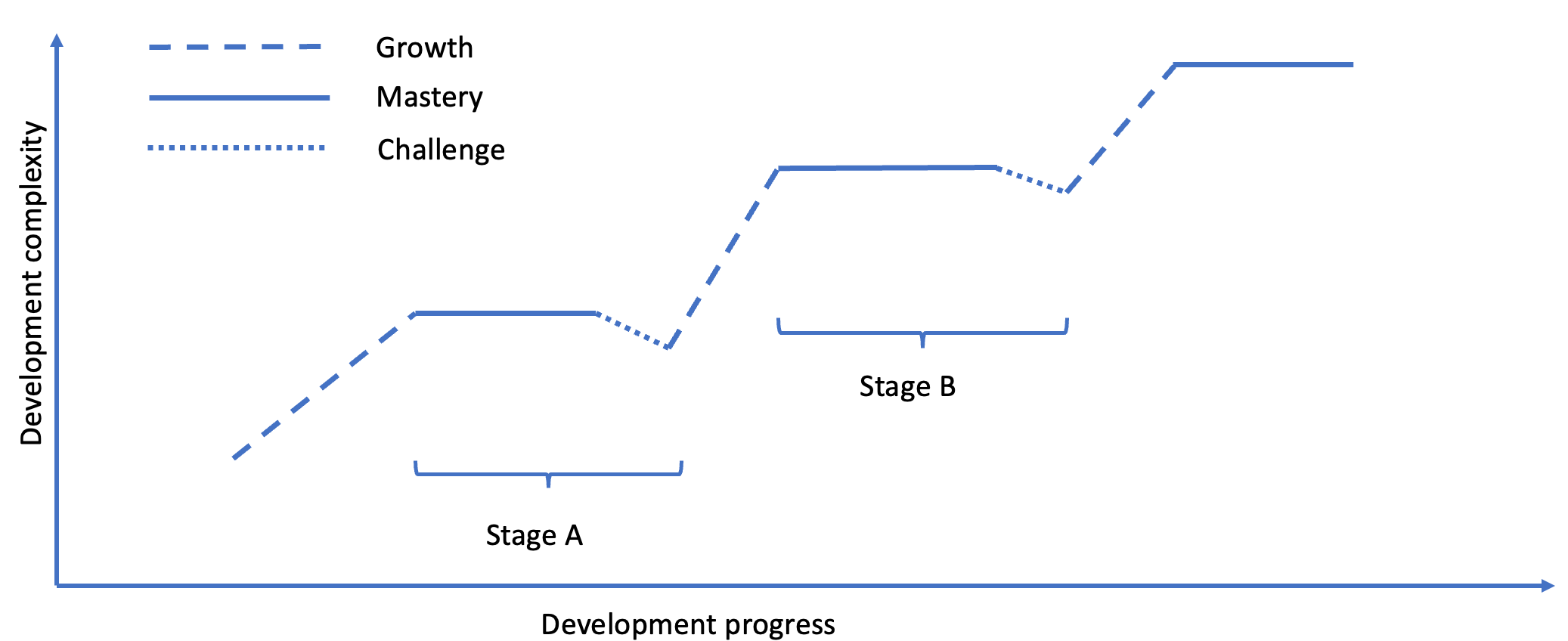
Using the writing model again, young school children are carefully guided through a process of increasing challenge and complexity. After learning the alphabet and learning to write individual letters, they learn the magic of assembling letters together to represent the words they have been using verbally for years! After building the alphabet model, they start building their vocabulary, learning the letter arrangements that they attach to things around the house like car, rug and sink, while insisting you have to sound out the “s” in island, like I did. As they master each level of this model, letters, then words, then sentences, then paragraphs, at each level they attain mastery and confidence that they can write a sentence, for example, before they string a few of them together. So they go through a sequence of mastery > new challenge > growth > new mastery. It looks like this:

1 "Nine Levels Of Increasing Embrace In Ego Development: A Full-Spectrum Theory Of Vertical Growth And Meaning Making, 2013, https://bit.ly/2Abk0Ky Suzanne Cook-Grueter, a developmental psychologist, is the primary researcher for Ego Development Theory (EDT), a theory similar to Spiral Dynamics.
2 Jeff Saltzman, https://www.dailyevolver.com/#archives