
3.4 Self: Upper Left Quadrant
Self & Consciousness: Interior, Subjective, Individual
OK, I have looked at your diagrams and they are a starting place, but let’s start with a question, what am I supposed to get out of this Quadrants concept?
First of all, the Quadrants represent four different perspectives we can take when looking at our internal and external world. The first “big idea” is that the left-hand quadrants are called subjective or inter-subjective, which means our experiences are based on personal feelings, tastes, or opinions in the upper-left quadrant. In the lower left, we are dealing with the aggregated, cumulated, or combined feelings, tastes, or opinions of groups. So, the left-hand quadrants are the subjective quadrants. We might not want to base car repair or wiring our house too heavily on the left-hand perspective. While you cannot verify the accuracy of my feelings, common sense dictates you believe that I have feelings. I bet you, like most humans, spend a high percentage of your time either ruminating on or focusing on how you feel about something, what you like or dislike (taste), or replaying your rationale for spending so much money on that great deal you just got.
In contrast, our Modern (Orange in Spiral Dynamics) objective or inter-objective worldview is impartial and disinterested in our personal feelings, tastes, or opinions. Validity in the right-hand quadrants rests on facts about things that have physical existence or forces like gravity that are predictable, measurable, and can be verified by others. While some empirical or scientific tools have been applied to left-quadrant studies, they really shine in the right-hand quadrants, forming the foundation of the physical and life sciences, technology, and engineering. Our Modern age is based in the right-hand quadrants and has been immensely successful.
I think I have a handle on this left-hand, right-hand difference: the non-scientific and the scientific.
I would phrase it differently. “Non-scientific” makes it sound inferior. I think it is different, not inferior. People will have preferences for focusing time and attention on the left and right sides, but these are preferences or talents. Writing a poem (left side) or the perfect algorithm (right side) cannot be ranked on any single scale.
So let’s focus on the Upper-left quadrant to start. This is where we find, inside us and only imperfectly revealed to others, our feelings, tastes, and opinions. In my 2.0 to 2.16 posts, we spent most of our time introducing the Spiral Dynamics development theory. Let’s start by looking at the upper left quadrant in the diagram below.1 The contents of the quadrant are organized as a holarchy, each stage transcending and including the previous stage. Other development theories have different holarchies covering other human capabilites: cognitive skills, emotions, interpersonal skills, spiritual intelligence, and identity growth, to name the most familiar.
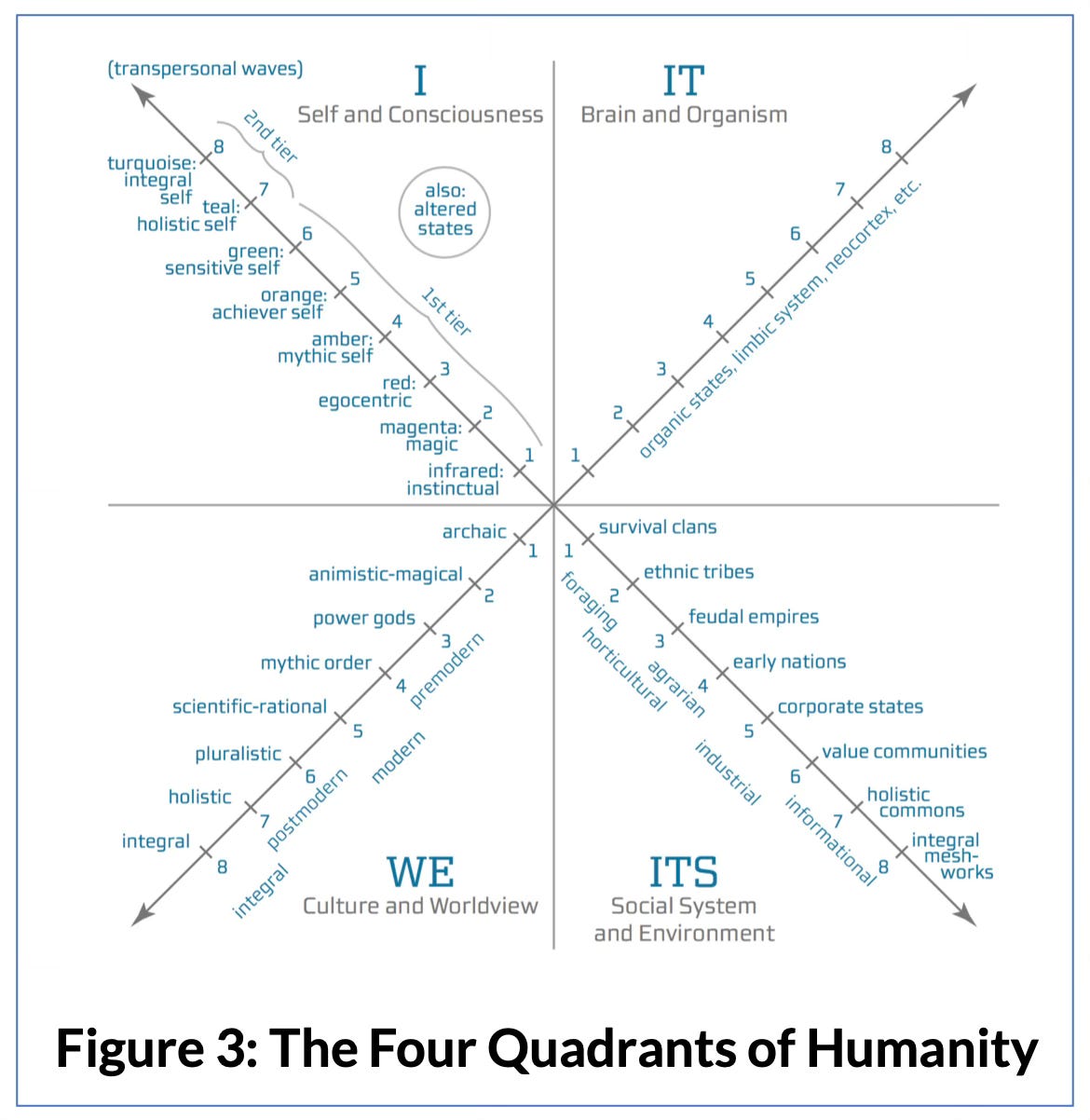
Let me be sure I understand you. You are saying that the theories that we find in the upper left cover Human Development of different kinds, like the ones you just mentioned. So there are several theories in this quadrant. Is that true of each quadrant”
Yes, but let’s stay here for now, where we deal with really important but admittedly amorphous subjects around feelings, tastes, and opinions.
OK, if we can’t use the scientific method to find “truth” here, how do we do it?
Great question! This is when “Quadrants” really started to make sense to me. Because the scientific method has limitations here, I was really stumped about your question. Wilber describes the “validity” finding process in the internal subjective quadrant as what was called “Truthfulness” by the German philosopher Jurgen Habermas.1
Haven’t you just punted?
No, I think this gets juicy now. In the upper right science quadrant, scientists propose a hypothesis and design experiments to create evidence about whether the proposition is true: Propositional Truth. If I say the sun is shining, you can go outside to check and see.
If I say my stomach hurts, I might be telling the truth, but I might not. I could be distorting, concealing, misleading, lying, or delusional. The truth is inside me, and you have no sure way to verify it, not even with medical tests. Science works with objective truth, but here we are dealing with subjective truthfulness.
How do we get to the truth, then?
The method is to evaluate my sincerity, integrity, and trustworthiness. In most of our dealings, we probably have little problem with figuring out truthfulness. Still, if I begin to display a pattern of being insincere by faking, exaggerating, or failing to follow through, you may begin to question my integrity and doubt my trustworthiness. When I promise to pay you back next week, you decide not to loan me the $1,000 I desperately need. Our verification processes in the upper left are messier than in the right objective quadrants.
Saying it like that, it is really scary to think about damaging my truthfulness.
Yeah, I think that is why they say you can build a reputation over 20 years and break it in 5 minutes. There is a lot of intrapersonal work—knowing oneself—and interpersonal work, building the consistent evidence of trustworthiness that goes into establishing a foundation of truthfulness.
One more comment about this. Even if you have done all the right things to establish your reputation, the world is not always fair. As we veer more into a non-truth culture, more of us become vulnerable.
Pages 98-108 of A Brief History of Everything, by Ken Wilber, provide the background for his narrative about “validity claims” for the four Quadrants.