
3.5 Culture: Lower Left Quadrant
Cultural Worldview: Interior, Subjective, Collective
(NOTE: If you are new to my site, it helps to read the posts in order. They are listed under the Contents tab here.)
Let’s start the 2nd quadrant review by orienting ourselves. Last week, we covered the upper left “I” quadrant. Today, we stay on the left side, Interior and Subjective, and move down to the “We” quadrant, which includes the Collective: couples, families, schools, churches, workplaces, cities, and nations.
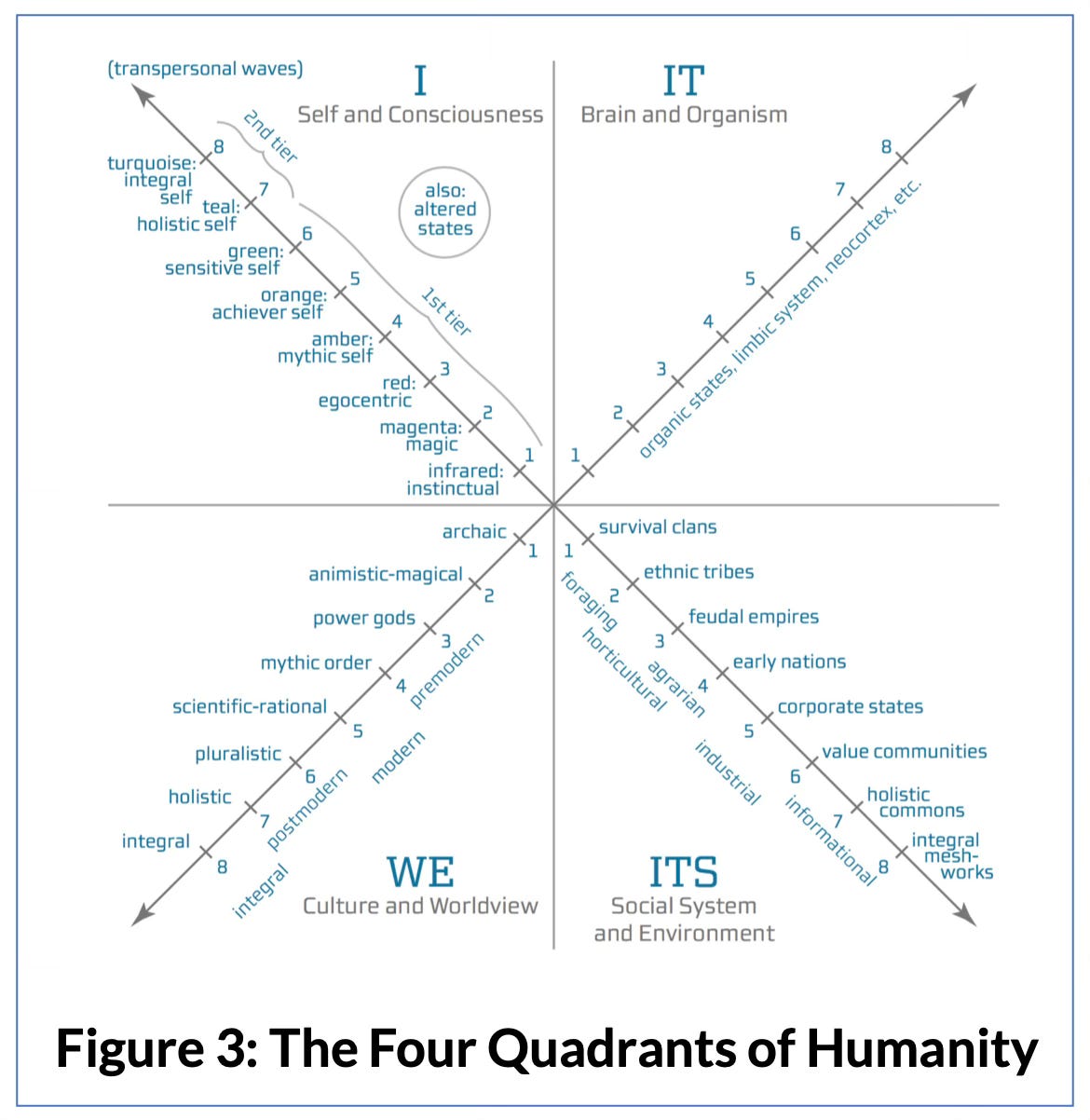
Remember from the last post that the Upper-left quadrant deals with individual feelings, tastes, or beliefs. Today, in the Lower-left we are dealing with the combined feelings, tastes, or beliefs of groups. In the Upper-left, to validate “truth,” we used “truthfulness” as our standard. Moving to the Lower-left, since we are now in the realm of the collective We, we move into the realm of morality and use the standard of “rightness.” Being truthful in the company of others becomes a moral standard that families, groups, and cultures establish to manage our interpersonal behavior. Things can get chaotic without standards set by nations, families, groups, religions, or other institutions.
The Upper-left locates my internal experiences. Lower-left is where I engage my inner reality out in public. Is that about right?
Close. There are two more quadrants, two more realms of our reality that we will cover. But this “tour” starts with our personal internal experience and then moves those experiences into our interactions with ever-expanding circles of others. As our inner feelings, tastes, and beliefs come into contact with others, we experience a range of responses, including anxiety, fear, elation, confusion, anger, joy, and so on. Then, our responses get mixed in with the other group members, and we create a “group average” that roughly describes the group’s experiences, abilities, culture, and worldview. So, we engage each other here, but the subject of our study in this quadrant is the group and our collective experiences, not individuals.
What are some of the development theories in this quadrant?
Anthropologists can study the developmental growth of culture-based worldviews and values. Philosophers can study the evolution of philosophical schools of thought. Linguists might look at the evolution of how languages express more and more complex or subtle meanings. Theologians can study the evolving meaning of core principles in religion: origin stories, the role of god or gods, the relationship of religion and ethics, and so on.
You mentioned that we validate truth in this quadrant by the standard of “rightness.” Can you say more about this?
Sure. First, I think it important to say that there is an ongoing “dialogue” between the quadrants, and it is probably easiest to see this between the two Left-hand quadrants. We often find ourselves “talking to ourselves” about things that happen with other people. Our intrapersonal dialogue might include thinking about whether my comments in the group were valid, or what I really believed, or whether I was clear, and maybe realizing I could have said things differently. Or perhaps I now realize that what I said is not what I think.
After I’ve had this little chat with myself, I rehearse my next conversation, but now other people are there and it goes differently because new ideas or social dynamics are in play. So now I think, “Should I bring up my new insight?” or is it irrelevant? As you know from daily experience, we continually review and rehearse our individual and collective internal, subjective experiences. And, for most of us, who shows up in “the collective” can significantly affect how we show up.
Into this mix of internal chatter and external social behavior comes the question, “How do we know what is true?” In A Brief History of Everything, Wilber uses four terms for the Lower-left validity claims: justness, cultural fit, mutual understanding, and rightness. Just as his four terms for the Upper-left quadrant helped us get close to touching the “real thing,” these terms help us triangulate the truth here.
Okay, I’m all ears!
Starting with rightness and justness, they elicit synonyms like moral, fair, impartial, righteous, and virtuous. Based on whose standards? Well, the culture we are operating in. We have some issues in the Green, post-modern, pluralistic, relativistic worldview, but this is a recent development, and our culture’s center of gravity is not post-modern yet. However, we are having many conflicts with Greens about this fluid state of affairs, and I will comment on it in other posts. For now, I think “mutual understanding” is a pretty good interim goal to work towards.
Wilber points out, for example, that we have deeply engrained habits and trust that when I say “dog,” you know what I mean. It’s a remarkable cultural feat when you think about it. We are admittedly having trouble when I say “equity'“ or “equality” that we know what we mean by these words. Our shared work is to work for shared meaning, so the Venn diagram circles overlap enough to get along in a state of “common good.”
I think I’m starting to get this notion of multiple perspectives. On the one hand, it is good to understand the level of development of you and me, what we can mutually see, and what we see differently because we are at different levels. Now, with two of the four quadrants, the two subjective quadrants, we have to consider being open to all kinds of variables so we can get closer to “truth.”
Remember, the Big Three, the Good, the Beautiful, and the True. This Lower-left quadrant is the Good, which we must strive for here.