
3.6 Science: Upper Right Quadrant
Exterior, Objective, Individual
[Note: This is a repost of an earlier version of post 3.6, correcting some errors and cutting out material that warrants a separate post. This version focuses more directly on the specific content of the Upper Right Quadrant.]
After finding that we validate truth in the Upper Left Self quadrant with “trustworthiness” and in the Lower Left Culture quadrant with “rightness,” it feels like we are coming home to the “true north of truth” in the Upper Right quadrant. I remember reading The Canon by Natalie Angier, hoping it would give me the basics of determining truth. This was a book about the hard sciences and how they are done, using experiments and statistics to describe the level of “confidence” we can have that something is true, or, in other words: accurate, verifiable, “in accordance with reality,” “what really happened,” “honest-to-goodness,” and “the real McCoy.” As soon as I downloaded that clear understanding of the pathway to the truth, I could apply it to what people say and do so I could helpfully point out where they were wrong.
How did that turn out?
Well, as you have seen in 3.4 and 3.5, you can’t use the tools of science in those Left-hand quadrants. At the same time, scholars and sages have developed pretty nifty tools to attain levels of trustworthiness and rightness in those quadrants.
So, now we get to return to the solid ground of the hard sciences, a place that makes many of us happy, feel secure, and know that things will stay where we put them.
What kinds of development theories show up in the Upper Right quadrant?
Well, for starters, since the Right-hand quadrants are about the physical universe and the forces and processes that act on material things, the output of scientists is more along the lines of models or maps, as Wilber would say. These models reveal physical forms and living organisms of ever-increasing complexity. In the diagram below—which you have also seen in the previous two postings—the Upper Right quadrant lists the organic structures of the nervous system becoming more complex as they develop. That complexity is necessary for the increasing capabilities listed in the Left-hand quadrants, so one of the qualities of all four quadrants is that they co-develop and are interdependent.
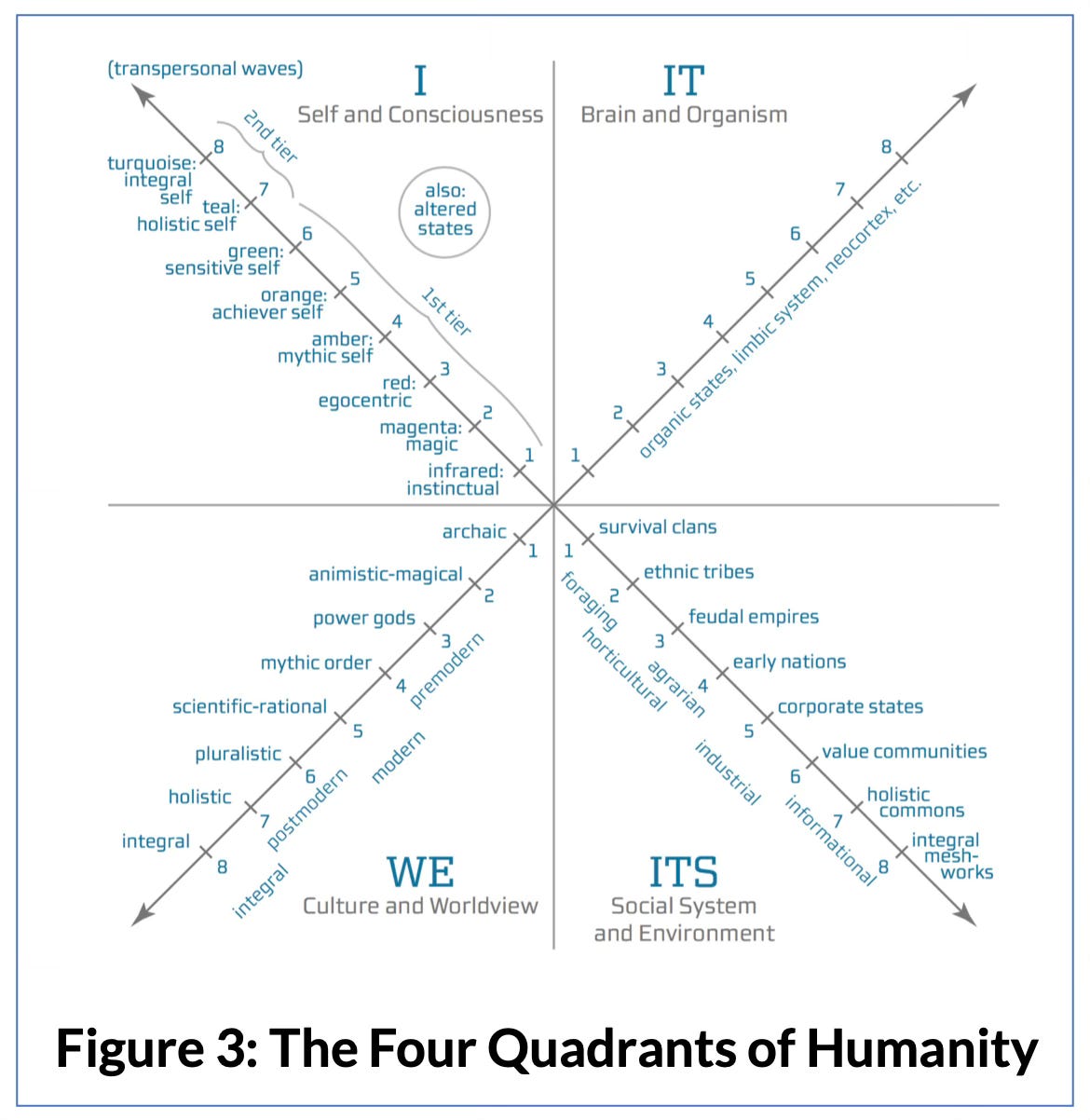
Since this is a diagram of the four quadrants of humanity, or human beings, the structures of increasing complexity in the human nervous system start with the organic states being sensed to synapses to nerve cells, to the brain stem, to the limbic system, to the neocortex.
If we were looking at physical structures, processes, and energy beyond the human body, we would be in other scientific fields that reside in the Upper Right quadrant like:
Biology
Physics
Chemistry
Geology
Astronomy
etc.
What are the tools in this quadrant?
The tools support the over-arching process of getting to the truth, the scientific method. In simple terms, scientists observe physical things or forces interacting with material things, like the force of gravity, or the transformation of physical things, like chemical changes. Next, they devise hypotheses to explain those observations and design and conduct experiments to test their theories. The experimental design is a crucial step because there are opportunities for uncontrolled variables to be present, leading to results mistakenly attributed to the experimental variable.
I’m not sure what you mean.
Let’s say you are testing an ointment for a rash but don’t measure the sun exposure the subjects received. The changes in the rash might be affected more by sun exposure or sun plus ointment than by the ointment alone.
Next, the researchers analyze the data obtained from the experiments using statistical confidence tests and draw conclusions based on the evidence gathered. A vital step before publishing results is peer review, where other scientists in the field evaluate the entire project. This can control for faulty design, data, and statistical analysis.
This process is iterative, with conclusions leading to further hypotheses and experiments, building our scientific knowledge.
And what are the validity tests in this quadrant?
Remember our list earlier: accurate, verifiable, in accordance with reality, what really happened, honest-to-goodness, and the real McCoy. The technical terms Wilber uses for the validity tests are propositional, representational, and corresponding.
that a statement is true if what it proposes matches an objective fact
statements are true, or the map matches the territory if they match what the words represent, or there is a direct correspondence between the statement and objective fact.
It troubles me when I hear about scandals related to scientific studies. It’s like the scandals when “trusted” adults molest children. These stories undermine some of our most vital roles and institutions.
Remember when I said you could work 20 years to create a good reputation and ruin it in five minutes? The only thing that makes reputation repair easier in the Upper Right quadrant is that it is possible, using science tools, to be utterly transparent since this quadrant is exterior, visible, and verifiable.
I don’t want to ignore your issues, but I will cover them in a different post. Science is experiencing a crisis of confidence for several reasons, but I will review them carefully soon.
Thank you so much for doing this This seems very complicated… I think I need you to outline what it is before you say all the things that complicate it! Let me read it 20 more times!
Your article starts by calling the right upper quadrant interior, I thought it was exterior?