
4.0 Lines: A Thought Experiment
In which we explore an Integral element that is overlooked, but rich with opportunities for understanding our world.
(NOTE: If you are new to my site, it helps to read the posts in order. They are listed under the Contents tab here.)
Another thought experiment…I like them!
Me too, but you know, they are more like natural experiments we can conduct in the left-hand quadrants, in the laboratories of our minds. We can create and maintain the standards of excellence we want to apply in our lives.
To keep this simple, let's use three questions to demonstrate how the Lines element gives us insight into understanding how we’ve navigated our world in the past and present and how further growth might lead to improvements in the future.
Sounds like a kind of “practical philosophy.”
Integral Theory is an overarching philosophy of living. Wilber calls this enactment of the philosophy “Integral Life Practice” (ILP). Integral sees body, mind, and spirit integrated, so life practices in these realms can affect our overall quality of life. The list of ILPs is long; for now, I will take a sample of three Upper Left Quadrant “lines” of psycho-social development framed as questions.
What do I need?
Who do I care about?
What do I believe?
What do I need?
Abraham Maslow’s hierarchy of needs model, which he developed in 1943, displays the rough sequence of human needs we encounter in our lives. Most of us readily recognize Maslow’s stages in the diagram below. Starting from the bottom, we face the most basic survival and safety needs. As we master them, we next work on relationships, love, and self-esteem. The pyramid shape is representative of the portion of the population that may be working at any of the levels at a given time. Although most of us in modern America may believe we have solved our physical and safety needs, we should stop and think about this. Why are these issues so central to our politics, government, and financial decisions if they have been resolved? We may be spending more time, energy, and attention on these two basic levels and finding less bandwidth available than we thought for love, belonging, esteem, and self-actualization. I know that when I retired, adjusted to living on a fixed income, and no longer cared about career and personal achievement, the top three levels of Maslow’s pyramid lit up much brighter for me.
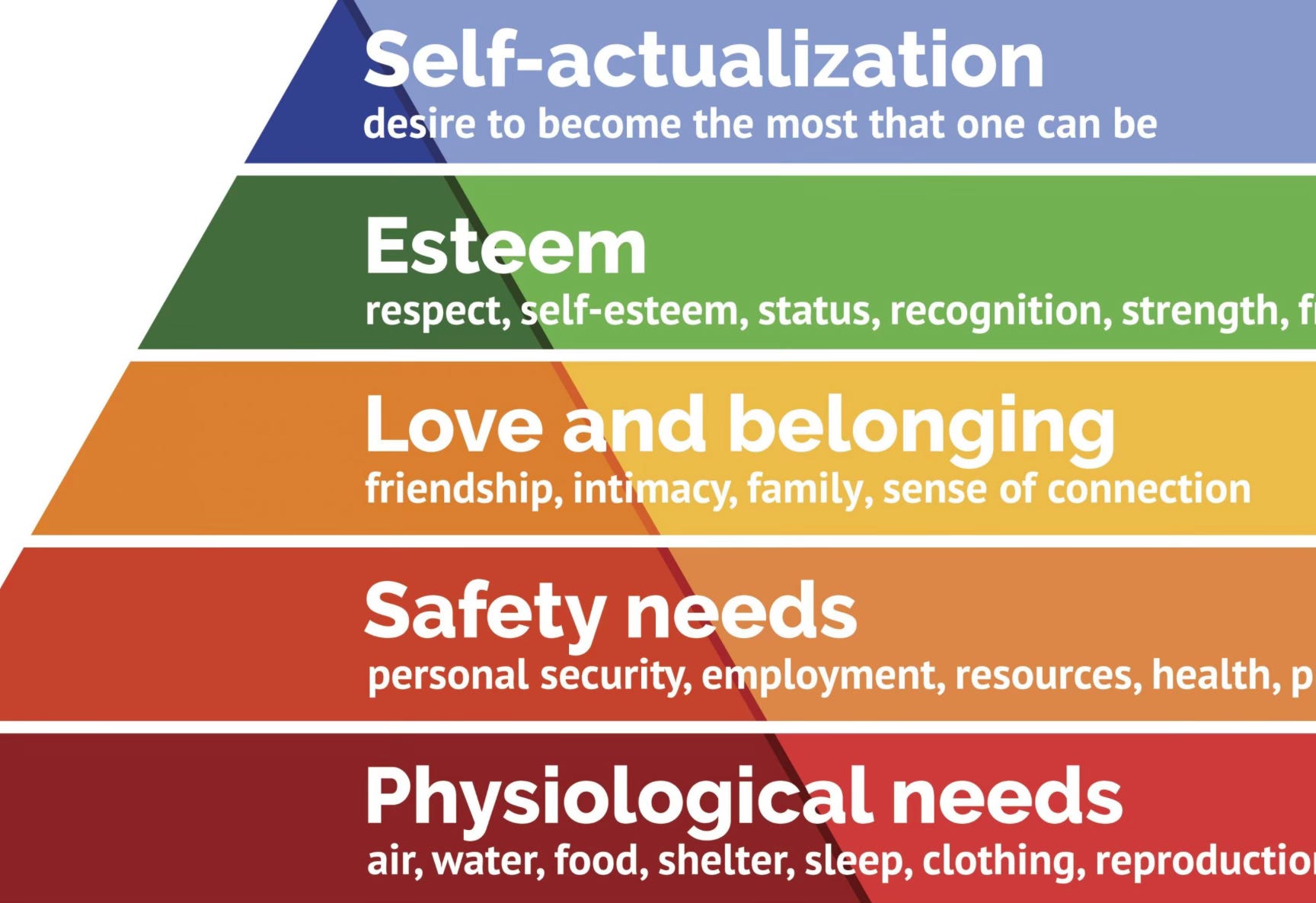
What do I need? Right now, life is stable, so I can work on the top three levels most of the time. But I also see that we can buffer or protect ourselves against major hardships, so nothing is guaranteed. “There, but for the grace of God go I” is a phrase we should keep in mind.
Who Do I care about?
Ken Wilber’s enhanced articulation of Carol Gilligan’s levels of care theory has four levels:
Stage 1: Selfish. We do not yet have the physical or psychological skills to care for ourselves, so to the extent that we attend to others, it is mainly to ensure that they are taking care of our needs.
Stage 2: Care for us. As we become confident in our ability to reliably manage our physical and safety needs, our outward attention expands from self-preservation to caring for the immediate circle of people we rely upon. Reciprocity becomes a significant feature in our skill set at this stage, but it is limited by our experience and understanding of how the world works. I care deeply about the well-being of my family, most of my neighbors, schoolmates, and church members. Reciprocity within this circle is a straightforward equation of “this-for-that.” Reciprocity beyond this close circle of family and friends is beyond our means in terms of time or treasure.
Before we go on, remember that these stages are fluid. Just as the outward circumstances of Maslow’s hierarchy can change quickly, our immediate focus of care can change. Lack of food, drink, sleep, and dry and warm clothes can quickly reorient our attention and who we care about.
Stage 3: Care for all of us. This is a monumental psychological and social leap for humans. Our Stage 1 self-centered cries for food or warmth come from our inability to provide for ourselves. Our Stage 2 understanding of reciprocity teaches us how to love and care for others, a beautiful new capability that enables our survival and gives great pleasure. Stage 3 caring for all people can be a big stretch. Why should I care for people who cannot, or might not, ever reciprocate that care? Some of us are lucky enough to have great teachers or role models who lead us to experience the reward we get for the generous love of the stranger. The parable of the Good Samaritan is one of those lessons that bridge the gap between Stage 2 and 3 levels of care for others. This is just the transition we need for the survival of our species.
Stage 4: Care for all life and our environment. Just as the Stage 2 to 3 transition is essential and difficult, we need a cohort of leaders who can lead enough of us through the Stare 3 to 4 transition. We can look at this transition as potentially more accessible. Our affection for nature and animals has a broad, multi-stage appeal. Even if we worry that the cost of environmental protection will be steep, after living in the Stage 3 condition of caring for all people, we will more easily see that Stage 4 is just a more full-fledged version of “Caring for All of Us.”
What Do I Believe?
James Fowler’s Stages of Faith is better known, but I think M. Scott Peck’s simpler 4-stage model provides a model for thinking about spiritual growth.
Stage I: Chaotic-Antisocial. This first stage sounds similar to Wilber and Gilligan’s first stage of self-centeredness: one’s most significant concern is only for oneself. While most of us grow out of this stage in childhood, both children and adults who remain in this first faith development stage can be defiant, disordered, egotistic, and have little to no development of empathy for others.
Stage 2: Formal-Institutional. This is a necessary developmental stage for all of us when we develop fundamental self-discipline and learn the norms of our communities (people “like me”). This is a stage of religious fundamentalism: right vs wrong beliefs and strong, unquestioning loyalty to leaders. In extreme forms of Stage 2, no alternative beliefs are tolerated.
Stage 3: Skeptic-Individual. Here, we develop a self-reliant and logical search for knowledge. The serious questioning of Stage 2 beliefs and the unsatisfactory answers provided by Stage 2 authorities can lead to agnosticism, atheism, or a gradual drift from religious life. Without a suitable replacement for their previous belief system, cynicism or emptiness can result. The thinking tools of science can support this loss of faith, but the marvels of scientific discovery can also keep a sense of mystery and wonder alive, leading to Stage 4. Most Christian churches have no developmental pathway from Stage 2 fundamentalism to Stage 4.
Stage 4: Mystical-Communal. To get to Stage 4, we must let go of our absolute dependency on binary thinking: Right vs Wrong, or Good vs Evil. As we have discussed in previous newsletters about Stages of Development, Stage 4 is similar to the transition between Tier 1 and Tier 2 in Spiral Dynamics. (More here, here, and here.)
“Beauty, mystery, and deep interconnectiveness of the natural world is more apparent…We gain awareness of an underlying reality deeper than mere comprehension… The role of one’s intellect is increasingly informed by the apprehension of one’s heart...Forgiveness, mercy, compassion, and love form the lenses through which others are viewed. Judgement of others and the desire to inflict punishment is set aside…Attachment to one’s own ego loosens. Forgiving one’s enemies becomes more natural as one fails to see others as potential enemies…Those residing in Stage IV are often called Mystics.” ~https://bit.ly/3IxSZlD
Are there other Lines of development?
Yes. I will fill in more details next time. Today we have just gotten a taste of the individual, semi-independent ways in which each of us may develop.