
4.2 Report Card
Looking inward and outward with Lines.
A Report Card
Let’s imagine we develop a personal report card to assess our progress along the lines of each of the questions from the previous newsletter. As far as I know, no developmental assessment tools provide this kind of multidimensional development feedback, but let us imagine there is, and this could be the sketched-out results of an individual’s report card, or, as Integral calls it, a “Psychograph.”
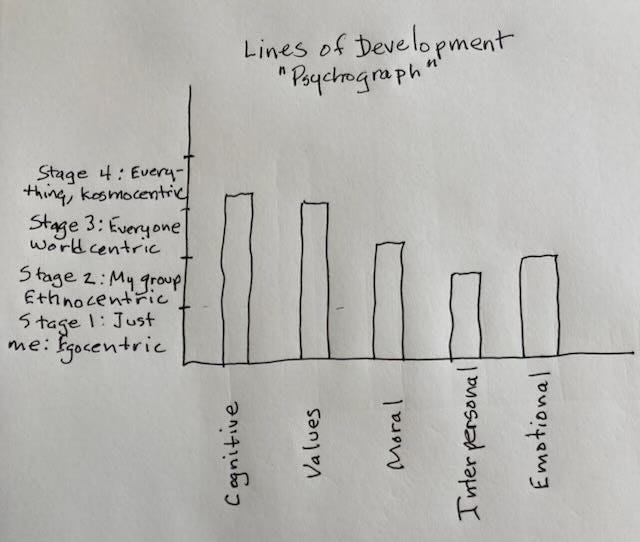
Let’s use this diagram to learn a few things about this individual. Remember in our last post, we described the four categories of Lines of development: Cognitive, Inner Self, Expressed Self, and Talent. The person above displays a well-developed Cognitive Line, which means that their ability to learn, manipulate ideas and information, and express what they know is strong. It also means that they have, if exposed to the theory of Integral Theory, some ability to boost their development in the other lines. This is the psychoactive quality of Integral.
The Values and Moral Lines are Inner Self lines and are shown here as slightly less developed. While this person might be Worldcentric in their thinking about what they hold as important, i.e., their Values score, when it comes to actual decisions, they lag a bit—the Moral score.
Finally, our friend has difficulty matching their feelings—the Expressed Self—with their values—the Inner Self. In other words, they can quickly lose their temper (fight), walk out (flight), or find themselves speechless (freeze). Try as they might, they can best manage them when they are amongst people who are like themselves. This is a clear indicator of the Stage 2 Ethnocentric level.
There are all kinds of variations in possible Psychographs, which leads to our differences. Despite the general similarity of people in the different stages, these variations help us understand that while our “center of gravity” might be the same, most of us have one or more outlier lines that can confuse how we view ourselves and our armchair assessments of others. This does not disprove development theories. Instead, it highlights the genius of clustering the Internal, Subjective, and Individual theories in the Upper Left Quadrant. Humans are complex. Lines help us reduce that complexity, if only just a little.