
Chronic Pain
It's effect on my writing.
Question: Where have you been? You’ve been very quiet.
I’ve been reluctant to write this post. I don’t mind talking about myself when it pertains to my views on Integral Theory or current events, but when the story is about a persistent health problem, I’m more private. Since you ask, I want to explain to my friends why I’ve posted only a few times in the last two months and what I’m doing to focus better so I can resume writing.
Since my subject is Integral Theory, I thought it would be useful to demonstrate how the Quadrant’s element of Integral can be used to organize information about a complex subject. I’ve been keeping a log of impressions and facts about my experiences and using the four Quadrant categories to organize my thoughts.
Drawing on the four Quadrants, starting at the upper right and going clockwise, the description below will start with Objective Facts, the Systems and Institutions I’m working with, Cultural factors, and my Subjective internal experiences.
As you remember, Integral is sometimes called the Theory of Everything, and Wilber simplified “everything” into these four categories that cannot be reduced further. You don’t have to use this approach for everything, but when a topic or issue is complex, it helps you sort out the questions and ensure you aren’t overlooking anything important.
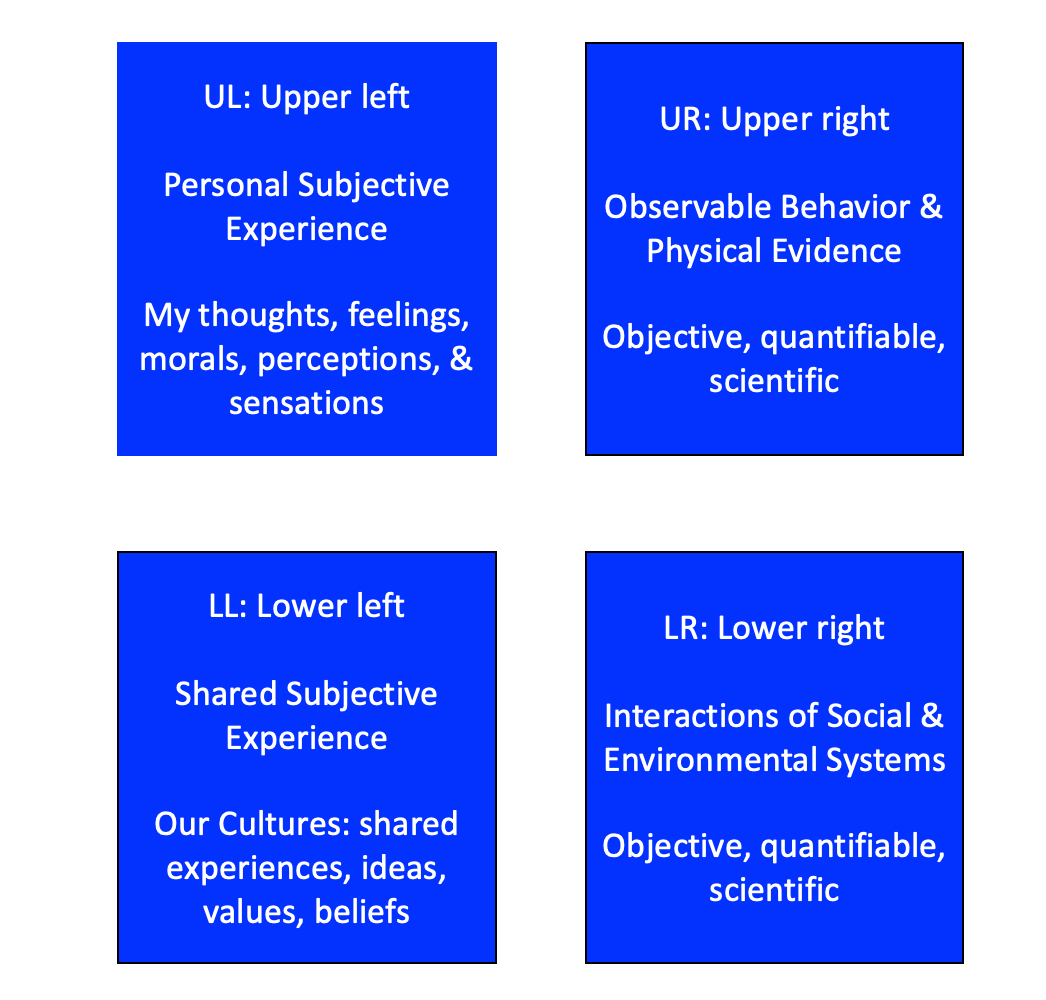
Quadrants are explained in greater detail in some of my earlier posts. When I use them to evaluate a complex problem, I like to start in the Upper Right (UR) Quadrant. Here, in brief, are the facts of my case.
One year ago, my hip flexor began to hurt. After a month of increasing pain, I went to my doctor. A hip X-ray showed little more than age-appropriate wear and tear. I was referred to physical therapy, but the pain increased and spread to my thigh and around to my hip and lower back. During the first five months, my ability to stand up straight worsened, and by June, I was using a walker to get around safely.
I’ve had 2 MRIs, both showing normal degeneration. The images guided doctors on where to perform further testing with diagnostic injections. One of the six had a positive result, so I will have a steroid injection in my iliopsoas bursa in one month.
My pain “complex” continues to worsen slowly. I have 2 more diagnostic injections, one treatment injection, and one nerve conduction test scheduled in the next month.
The only tentative diagnosis gained during this 12 months is iliopsoas bursitis. This explains some, but not all, of my symptoms.
The Lower Right (LR) Quadrant represents institutional and systemic issues. For me, the impact has been long delays between appointments, referrals, and tests. I’ve experienced gaps of 2-6 weeks between these events, with only moderately effective pain management. My complaint is not with the people who work in Medicine. The system sucks!
The cultural and social aspects of the Lower Left (LL) Quadrant have not played a big role in this story. I grew up in a family that did not ask for help from others, so I’ve asked for help with a ride or a task only a half dozen times. My wife, on the other hand, has taken up much of the slack caused by my infirmities. At times, this has caused unhappiness when the load passed the breaking point. For the most part, though, she’s been a star, and we’ve weathered the storm well.
Q: Okay, but how has this affected you?
Needless to say, the Upper Left (UL) Quadrant is where we find my personal, subjective experience. I’ve experienced fear, short periods of depression and anxiety, and sometimes anger. The prevailing subjective experience has been pain. For the first eight months, I found pain-free positions to sit, write, and conduct research for Glimpsing Integral. In the last five months, I’ve been affected by higher levels of pain and pain medications1, making it difficult to do work that requires concentration and sustained effort until the last few weeks.
Recently, I realized that I have been seeking relief from external sources—doctors and medication—to solve my problem. Most of the work has focused on finding what they call the “pain generator” and treating it. This assumes there is a physical source they can trace my symptoms to. But what if there isn’t? Or what if treatment only solves some of the pain?
Q: One of my biggest fears is chronic, unbearable pain. Are you afraid of that? Has anyone suggested that might be the outcome?
In a discussion of the diagnostic tests we’ve done and those that can still be done, I asked whether it was possible that no pain generator could be found. That neurosurgeon said yes. That was a frightening and depressing moment. I’ve recovered from that moment because:
We’ve had one tentative positive response: IP bursitis, which can be treated with a steroid injection, which is scheduled.
There are still more tests that can be done, and three are scheduled in the next six weeks.
There is a psychology-based treatment for “neuroplastic pain” in the Upper Left (UL) Quadrant called Pain Reprocessing Therapy or PRT.
One source of hope for me is that when medical doctors cannot find a pain generator, the cause might be neuroplastic pain. This is “learned” pain that PRT is designed to treat. It can have an initial structural cause, such as a pulled muscle or a broken bone, or it can occur after an illness,. It is pain that persists after the body has healed. The brain can remain on alert to guard against further pain or injury. Any minor increase in pain may be interpreted as evidence that it has not healed or is worsening. Worry about it leads to stress, hypervigilance, and increased attention, which in turn provide more evidence of pain. This sequence can repeat itself, with the pain worsening and spreading. This can cause the muscles in the area to be chronically constricted, leading to new pain and drawing the surrounding tissues to attention. This cascade can come on quickly or over several months. The original source might be forgotten, or, as in my case, it can be so painful, constricted, and attuned to the slightest physical trauma that it is in a cycle of continually re-aggravating itself.
In brief, Alan Gordon, in his book A Way Out, argues that we have two major tools to address neuroplastic pain. Our goal is to unlearn the pain cycle, which is paradoxical; one can’t just command it to go away. When the pain level is high, he recommends avoidance behaviors. For me, since standing and walking lead to high pain levels, stopping those activities and sitting is the best avoidance behavior. Using a heating pad or a TENS unit usually helps when sitting is not enough. Pushing through high-level pain just reinforces the danger signal. That does not teach the brain that we can unlearn the neuroplastic pain.
When the pain is moderate or low, Gordon recommends a technique called Somatic Tracking. This involves sitting quietly with the pain, “watching” it, and labeling it qualitatively rather than by intensity. In other words, instead of focusing on how bad it is, reframe it as dull, achy, steady, sharp, pulsing, hot, stinging, etc. Daniel Siegel, in his book Mindsight, reports that this “name it to tame it” method has been tested, and research shows that the amygdala calms when we label emotions in these neutral, objective terms. Gordon says his work with clients shows that those who use these two tools consistently find their pain symptoms diminish and fade away with time.
Why has my pain persisted so long? I don’t know yet. If it is structural pain, according to the theory I’ve reviewed above, we may not have found the physical “pain generator.” If my pain is neuroplastic in nature, I may not have practiced the Gordon exercises consistently or long enough.
In the last month, I have succeeded in recalibrating my pain medication so it causes less drowsiness. Once we get through the holidays, I expect to resume a more frequent writing schedule. Fingers crossed!
Thank you, Gary, for your thorough explanation. Rather than intrude into your process with "helpful ideas," I am sitting/meditating with the knowledge you are facing a difficult and painful time in your life and I can do little or nothing to alleviate your suffering. Learning from this teaches me how to take the next step in this life of suffering, of love, of pinnacles and nadirs. Bows.
Hard-headed for soft(est) currency (ever) “healthcare” is dumber than a box of rocks & hammers & puts people into the proverbial hard place — with more than a little help from those same hard-placed people -- when it comes to soft tissue issues. I’ve my own experiences with this.
For whatever else it may be worth, working your iliacus is worth an experiment. See here:
https://www.alethahealth.com/en-us/lp/mark-discover
I saw your post over at McGilchrist’s stack, clicked over to yours & this particular piece. Random meander.