
Development, Evolution, Hierarchy and Holarchy
Clarifying terms.
What’s Up?
I want to clarify some wording that causes problems when I talk about Integral Theory.
In developing the theory, Ken Wilber spent a great deal of time reviewing and cataloging over 100 theories and models that researchers, philosophers, and wisdom teachers developed. He discovered that these theories and models detail the entity's movement from simple to complex and relatively static to dynamic. This movement is called development or evolution. I think of a lifetime as the context for development and many generations as the timeframe for evolution. Still, the difference is not so great that the terms cannot be used interchangeably.
But they seem to be different ideas.
Yes. “Development” works well when we are talking about the lifespan of an organism or a part of an organism, like a cell. Elsewhere, I use it to describe the “lifespan of a stage,” with entering, peak, and exiting phases. It can also be used to describe non-living processes like a storm or seasonal changes. “Evolution” captures the changes that occur over generations and take hold, like a genetic change that is successful enough that the species passes it on because it becomes more successful than the previous genetic code. Evolution is also used to describe long-term non-living processes like the life-cycle of stars.
These differences are shown in Wilber’s Four Quadrants, each of which contains many developmental or evolutionary processes. Remember that the top two quadrants contain the Individual Subjective (left) and Objective (right) development processes of individual lifespans.
The bottom row contains more evolutionary processes in that they may require generations before the cultural or social changes become apparent. That slow change shows signs of increasing as technology and communications speed up.
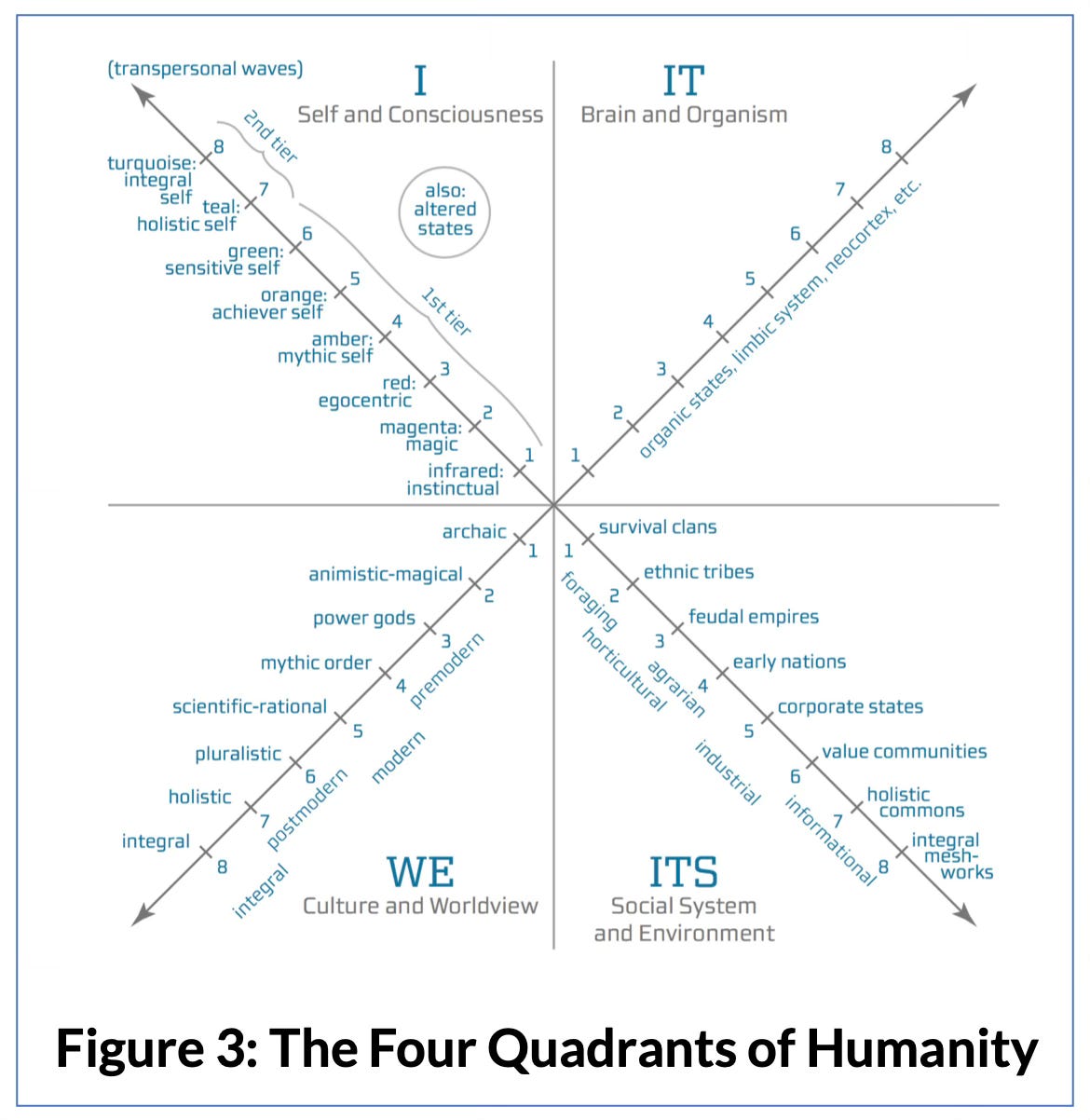
To keep it simple, let’s just discuss the top row. On the left side is a hybrid model of internal, subjective stages that humans may grow through in a lifetime. On the right side are our bodies' physical, organic systems that must mature to support the changes on the left side1. They are often referred to as the physical correlates of the subjective left-side experiences. Disease or injury to right side organic structures can slow, stop, or reverse cognitive and psychosocial development on the left.
These look like hierarchies, which I think means that things get better as they go up, right?
“Better” points to the problem I want to clarify in this conversation. If you look up hierarchy in the dictionary, two kinds are described. Integral distinguishes them as either power or growth hierarchies. A power hierarchy is “a system or organization in which people or groups are ranked one above the other according to status or authority.” Power hierarchies are found in “command and control” organizations that typically do work that requires a chain of command that enforces compliance. A good example of an appropriate power hierarchy is the command structure set up at the scene of a natural disaster. First responders know their roles and responsibilities; they are trained for emergencies, and when the event is over, they have an “after-incident review” that can lead to procedure changes and additional training.
Too frequently, power hierarchies are used to build a corrupt command structure where people use their status or authority to enrich or protect themselves and/or harm those with less authority. Integral and developmental theorists agree that power hierarchies can become unhealthy and have nothing in common with growth hierarchies.
Integral theory is not based on power hierarchies but on growth hierarchies, which are:
Increasingly complex physical structures: subatomic particles, atoms, molecules
Increasingly complex biological systems: organelles, cells, organs, organisms
Increasing inclusive ability to care: for myself, for people like me, for all people, for all life
Increasing inclusive worldviews: magic, mythic, rational, pluralistic, integral
Now consider this development life cycle: acorn > sprout > sapling > oak tree > snag. Is this a power hierarchy or a growth hierarchy? When you find yourself getting stuck on the idea that hierarchy = power hierarchy, remember the Oak Tree!
I understand you, but it is hard to accept that a more developed person is not better than a less developed person.
I know. I often slip back into “better/worse” thinking patterns, but a more empowering worldview opens up when we use the growth model.
Let’s move on to a new term that gets us out of this mess. Think about school children. Third graders are not “better” than second graders. However, they have the ability to include what they learned in second grade, into third grade, and thereafter. They learn more complex and efficient ways to solve harder problems, increasing their capability. We don’t see them as better kids, though. We just see they are more capable. Wilber’s expression is Include and Transcend: include what we still use from earlier stages and transcend older tools or views that don’t work in a more complex or demanding environment.
Here is a holarchical view of grade school:
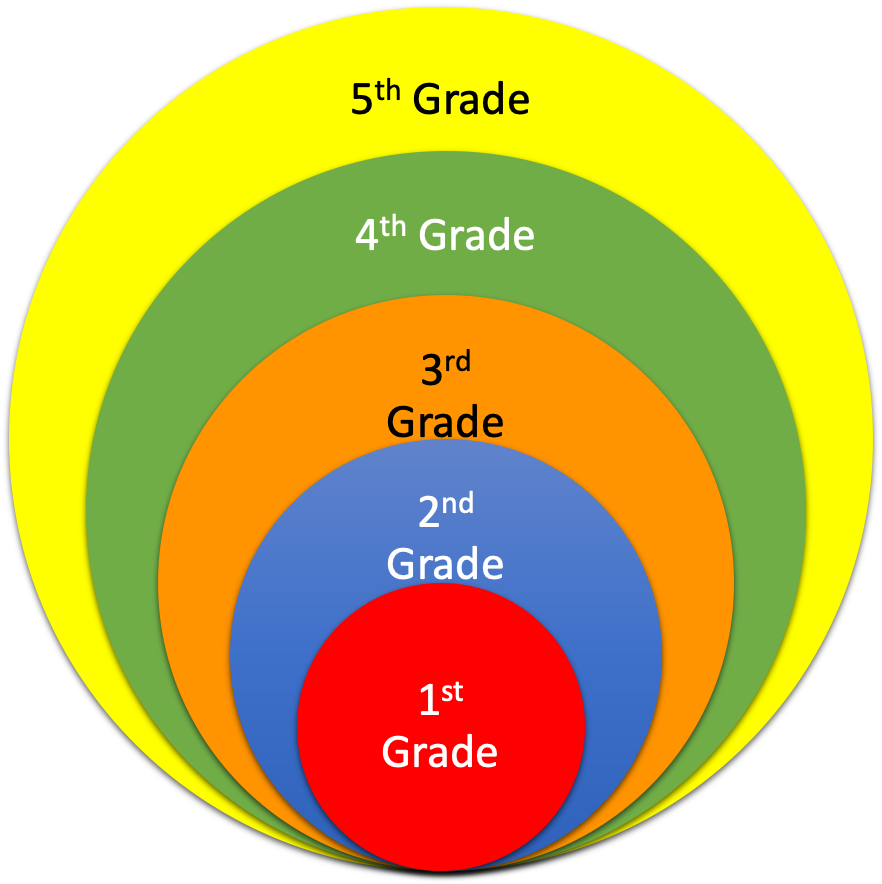
A “holon” has two qualities at once: it is part of a bigger thing, idea, or skill, and it is made up of smaller holons. The holons of a holarchy are interdependent all the way up and all the way down.
Hmmm, that’s not so hard to get.
That’s what I think! Now, if I can just train my brain to use the Holarchy model instead of Hierarchy! By the way, this image might help with understanding the five-stage model I use in Glimpsing Integral.
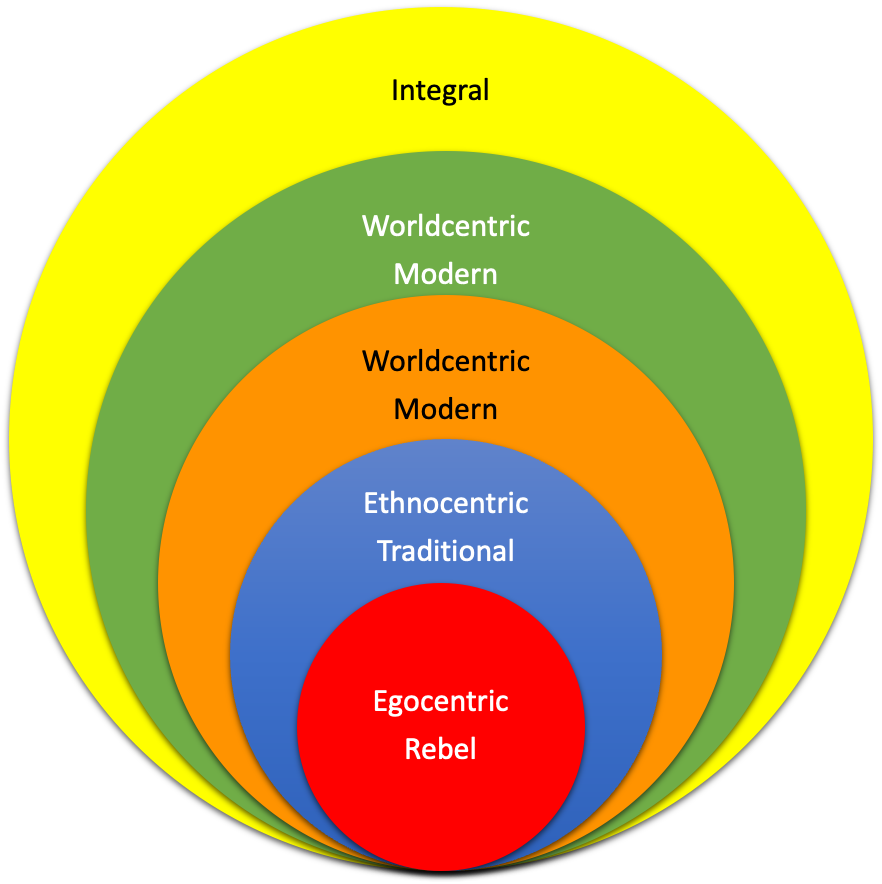
That does help. I’m struck by a couple of things. First, I retain parts of my earlier self. Sometimes they show up in useful ways… other times they might embarrass me. Second, whatever stage I’m at, there is still more I don’t know.
Yeah, we are just getting brief “glimpses” of the next stage at best, which is why we often have a love/hate relationship with people who may be further along. They may, even a little, challenge our competitive instincts to be the best, taking us back to thinking one stage is better than another. When we learn to accept each stage the way we accept 2nd and 3rd graders as no better or worse than each other, those judgments begin to fade away. When we look at a person at a more developed stage, if we replace envy with curiosity, we learn from their example and use it as a model for our own growth.
It seems like this hierarchy/holarchy idea is very important to you. Can you explain?
You know how Doctors say if they could package all the benefits of exercise in a pill, they would have the best miracle medicine of all time? I think of the combined work of researchers, philosophers, and wisdom teachers on the human development paradigm similarly. Embedded in the theories and the “Development Rules,” there is brilliant insight that unlocks a respectful, open-hearted view into the “beautiful mess” of our species. Once I saw it, I could not unsee it. In this Substack, I try to convey that brilliance to you.
The evil of power lorded over others in hierarchies should not be the excuse we use to throw all of this scholarship and search for wisdom in the trash bin. I understand the instinct to do so; I do it too. I write this to push against this tendency, hoping we can take advantage of slow, deliberate, contemplative thinking to understand the developmental worldview. The next step is finding and developing ways to bring this worldview to life. 📌
These systems are not described clearly in this diagram. At the bottom, we are dealing with the most basic neurological systems of sensation, monitoring and controlling breathing, heart rate, and chemical balances that take place below our level of awareness. Next, the limbic system controls emotions and fight or flight to protect ourselves from social or physical danger. The neocortex controls our ability to calculate, diagnose, and solve problems.