
Part 4, Evolution and Spiral Dynamics: Four Guidelines for Managing Developmental Differences
In Part 3, we moved from discussing structure to the human reality of stage transition, including what Orange and Green often get wrong when someone is moving out of Blue. Now Beck and Wilson synthesize the conversation into four practical guidelines for anyone trying to support healthy cooperation across developmental differences.
Wilson: What should Orange and Green really do when someone is making the transition out of Blue?
Beck: First, shut up and listen. I mean that. Don’t immediately validate them by saying “you’re so brave” or “welcome to the right side of history.” That turns their sadness into the story of your political narrative. It cheapens what they’re going through. Just patiently be with them; let them miss their friends; let them say, “Those are good people, but I don’t believe those ideas anymore.”
Wilson: Second, as we said before, offer concrete support. Get to know them. Ask about the kids. Invite them to do things, not just think things. The evolutionary replacement when one has lost their in-group isn’t a better theory. It’s still people who show up for you.
Beck: Third, even though they may eventually identify with new groups, don’t rush it. This person is in between worlds. They haven’t fully left one and haven’t arrived at another. That liminal space is unsettled, so it will be uncomfortable. Their list of changes is long: values, beliefs, meaningful stories and integrating the whole mix. Remember to just listen. If you try to rush them through it by giving them a new identity kit, you’re just moving them from one closed system to another, and it may not fit for them. Trust their process and be there when they need help. Think of yourself as a sponsor. You help them learn the ropes of the new world they are entering,. But be careful not to intrude or fix.
Wilson: We are trying to support a person in transition. From an evolutionary perspective, the person who deals with that discomfort and integrates it, especially if they can hold love for their friends and critique the system simultaneously, that person is developing a more integrated form of social intelligence. They’re building the capacity to cooperate across group identity boundaries. They may bring others along in time.
Beck: It’s the capacity we said was needed for the worldcentric transition. So, in a sense, this painful, messy, grieving process of leaving a group that no longer works for them, if it’s well-supported, is actually one of the primary engines of the developmental shift we’ve been talking about.
Just think about it. We know that Blue is probably the largest—percentage-wise—of the Spiral Dynamics stages. It may be the largest because of the very barriers to transition we’ve been talking about here. If we could mount an educational process for the Orange and Green stages to help them understand how they unintentionally delay development, perhaps we could release an untapped pool of people in Blue who would have changed but for the barriers we’ve identified!
Wilson: I love the instinct towards supported transition! Our psychology didn’t evolve for solo heroics. It evolved for supported transitions within a web of relationships. The person leaving needs what I’d call a transitional cooperative team. This is a group of people who can tolerate ambiguity, who won’t demand premature closure, and who will offer practical solidarity while the person finds their footing.
Beck: Keep in mind, this is a tall order. It requires Orange and Green to do their own developmental work. There’s a term in the developmental and Integral world, “mean green,” that refers to Green’s propensity, usually under duress, to label, deplatform, or cancel those it disagrees with. I consider this the shadow side of Green, and it constitutes the developmental work it still has to do. Green also needs to realize that Blue can’t skip Orange. That is developmental by-passing and it skips the foundation that healthy Green needs.
Orange also has a shadow side where its strengths, when overused, can turn into “mean Orange.” This would be taking individualism—this is an individualistic stage compared to Blue and Green—to an extreme, and not providing support for a Blue feeling all alone.
So Orange and Green have internal developmental work to ensure they support balanced manifestations of how we want people at these stages to evolve. And we need to help each stage work against their 1st Tier propensity for dualistic thinking. In our conversation, this refers to their inability to be sympathetic to those at earlier stages.
I know it is a tall order to sit with someone whose views are still partially formed by a worldview you find noxious, and to do so with patience and genuine care rather than thinly veiled disdain.
Gary: You’ve just discussed three ways we can help people through the transition out of Blue. Could each of you, from your perspective, summarize the four Guidelines you identified earlier as essential to healthy relationships between people and groups at different developmental levels?
Here’s what I’m trying to tease out of this: Should we focus our attention and energy on trying to improve how the stages work together, and, in doing so, create the conditions for overall development? Or do you think we should push this giant mass of people through the stages faster? This quote by Reinhold Niebuhr comes to mind:
Nothing that is worth doing can be achieved in our lifetime; therefore we must be saved by hope. Nothing which is true or beautiful or good makes complete sense in any immediate context of history; therefore we must be saved by faith. Nothing we do, however virtuous, can be accomplished alone; therefore we are saved by love. No virtuous act is quite as virtuous from the standpoint of our friend or foe as it is from our standpoint. Therefore we must be saved by the final form of love, which is forgiveness.
Wilson: That Niebuhr quote...Those of us who are planning change always have to adjust when our clients, customers, or citizens see the plans. When we are younger, we have little patience. When we are more seasoned, younger people think we have too much patience. All I know is there is always more to do and there will be more to do at the end of my life.
Gary, I have to sit with that for a moment because it captures something that I think the scientific framework sometimes struggles to articulate. But let me work through your request.
I know I will repeat myself, but I think the necessary conditions for stage change also apply to the necessary conditions for healthy relationships between the stages.
Guideline 1 — Structural Conditions. Cooperation doesn’t sustain itself on goodwill or hope. It requires architecture. Ostrom’s eight design principles are essentially the engineering specifications for cooperation at any scale. Shared purpose, equitable cost-benefit distribution, collective decision-making, monitoring, graduated sanctions, conflict resolution, local autonomy, and nested governance. These aren’t ideals. They’re functional requirements discovered empirically by studying what actually works across hundreds of cooperative systems worldwide. Without them, even the best intentions collapse under the weight of members who won’t cooperate. The structure has to be fair enough that our personal and group psychology can relax into cooperation rather than remain vigilant against exploitatio
Guideline 2 — Shared Challenge. When there is a shared challenge, such as the danger of over-harvesting a common resource, groups see an incentive to pay the cost of cooperation. This challenge, in turn, drives within-group cooperation. Clean water. Economic survival. A natural disaster. A problem that doesn’t care about your politics or your identity negotiations. The challenge creates what I’d call functional interdependence—the lived experience of “I literally cannot solve this without you.”
Guideline 3 — Maintenance of Existing Group Identities Within the Larger Structure. Much as Orange and Green would prefer otherwise, our capacity for cooperation: loyalty, reciprocity, shared norms, and willingness to sacrifice didn’t evolve as an abstract ability to work with anyone, i.e., including outsiders. It evolved as a capacity to cooperate with my people, insiders. These preferences are deep. They’re not cultural overlays. They’re woven into our neurology and hormonal systems, and reinforced by our emotional architecture. If you dissolve the group identity, you dismantle the psychological machinery you’re trying to recruit. But when groups feel their identity is genuinely honored, that same psychology becomes the engine driving the larger project forward.
Guideline 4 — Developmental Leadership. From an evolutionary perspective, this is the role of the cultural catalyst. Someone who understands the landscape well enough to reduce the costs of cooperation across group boundaries. They function as translators, trust-builders, and as living proof that expanded cooperation is possible without identity dissolution. Cultural evolution can move orders of magnitude faster than genetic evolution, but it still needs leaders. It needs people who embody the integration rather than just preaching it.
Beck: Let me take my turn from the Spiral Dynamics perspective. I’m largely in agreement, with some wrinkles and Spiral terminology.
Guideline 1 (Structural Conditions) is about creating life conditions that are healthy enough to support natural development. Every stage has functional and dysfunctional expressions. The Core Design Principles describe what healthy looks like at the structural level, and here’s the key insight: they describe it in terms that make it easy for every stage to recognize as fair, because they’re grounded in functional requirements, which don’t change at each stage like the values terms do. Blue can see the fairness and is not told it is backwards. Orange can see the efficiency and is not labeled as cold. Green can see the inclusion and sees that its concerns are covered.
Guideline 2 (Shared Challenge) is what I’ve always called the recognition that life conditions drive emergence. People don’t develop in a vacuum. They develop new perspectives and skills because their current way of operating no longer suffices for the problems they face. When the challenge is shared across stages, it creates what I call a meshwork — a functional collaboration that doesn’t require everyone to be at the same level. Blue brings discipline and commitment. Orange brings innovation and problem-solving. Green brings sensitivity to the impact on the people. Each stage contributes what it does best. Each stage is valued.
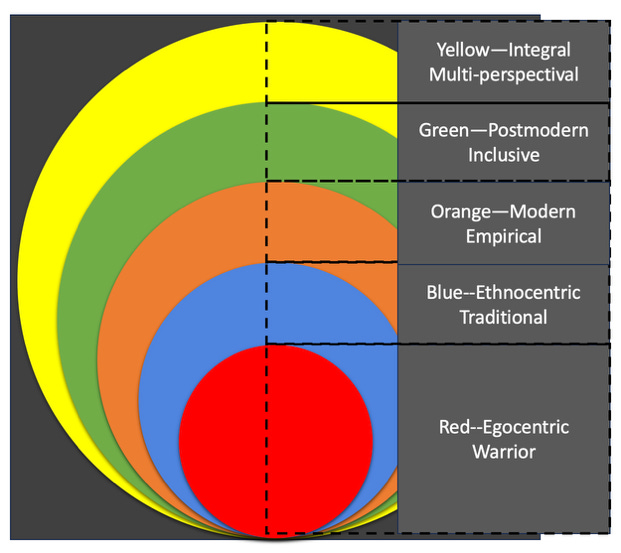
Guideline 3 (Protection of Group Identities Within the Larger Structure) is perhaps the one I feel most strongly about, because I’ve watched what happens when it’s violated. Every stage represents a legitimate solution to a particular set of life conditions. When you dissolve someone’s stage identity, you’re not freeing them. You’re removing their anchor. Anyway, that is not necessary; the Spiral is not a ladder you climb while kicking away the lower rungs. As the image shows, it’s a nested system where each level remains available. A person who’s genuinely developed to Orange or Green thinking if better off maintaining their capacity for loyalty, tradition, or group identity and including it within their larger framework.
Guideline 4 (Developmental Leadership) This is the work I’ve given my life to. I call it Spiral Wizardry. The ability to enter any system, meet it where it is, speak its language, honor its concerns and values, and gently expand its perception of what’s possible. Not by arguing from a higher stage. That kills the relationship. But by listening carefully, and when the time is right, demonstrating that the next step serves the values the person already holds. You show the Blue Patriot that their love of country is better served by institutions that function well for everyone.
Gary: Finally, in the last post in this series, we will return to the Niebuhr quotation and my strategic question: Is our project to enhance inter-stage cooperation, or to promote stage development, or…?