
References
When I quote an author, I will cite him or her in a post. If I make substantial references to the ideas from a paper or book, I will cite it. However, I have found that I have immersed myself long enough in this subject that the ideas I am writing about come from multiple written resources, get mixed in with conversations and experiences in my life, and come out in these posts. For many ideas, retracing their lineage is not possible, so this page will include those references that comprise my Integral Library. They contain the seminal ideas forming much of my content.
Books by Ken Wilber:
A Brief History of Everything, 1st ed. 1996, 2nd ed. 2001. Often recommended as an introduction to Integral Theory, but I suggest looking at A Theory of Everything or The Integral Vision for more concise introductions, both listed below.
Sex, Ecology, Spirituality, 2000. Wilber’s magnum opus. While there are several developments in the last 23 years that would update examples, Wilber says he would change little else. It is his most thorough book explaining Integral and probably the best single resource for Integral Theory. If you have read other books by Wilber, your will recognize many of those ideas here where they were gathered for a complete overview. I have found this to be a good source for clarifying some areas of confusion I have had.
Integral Psychology: Consciousness, Spirit, Psychology, Therapy, 2000. This includes an extensive list of developmental theories from a wide range of disciplines. These theories, when all laid out, led to Wilber’s eureka moment, realizing that they could be organized into the four Quadrants, a core element of Integral.
A Theory of Everything: An Integral Vision for Business, Politics, Science and Spirituality, 2000, paperback ed. A crisp, pragmatic introduction to Integral.
The Eye of the Spirit, 2001 An application of Integral Theory to psychology, spirituality, anthropology, culture studies, art and history theory, etc.
Integral Spirituality: A Startling New Role for Religion in the Modern and Postmodern World, 2006. I appreciate that Integral Theory has the flexibility and utility to enhance our appreciation for the religions of the world. It is especially useful in understanding how fundamentalist Christianity and mystical Christianity are part of the same religious lineage.
The Integral Vision: A Very Short Introduction to the Revolutionary Integral Approach to Life, God, the Universe, and Everything, 2007. This introductory volume has less text and more images and fills in some gaps that the other introductions miss.
Integral Life Practice: A 21st-Century Blueprint for Physical Health, Emotional Balance, Mental Clarity, and Spiritual Awakening, 2008. The developmental element of Integral is the best known and most referenced part of the theory. It engenders interest in our “self-improvement” muscles. ILP is a program for helping individuals to enact the lessons of Integral Theory into their lives and to support their development.
Trump and a Post-Truth World, 2017. This short book was written shortly after the 2016 election. For people unfamiliar with Integral, I think it would be a difficult read. I wrote a paper explaining my understanding of the book to define terms and clarify Wilber’s reasoning. Short take: Ego-centric Trump was supported by Ethnocentric voters who were fed up with the perceived arrogance of Postmodern progressives.
A Post-Truth World: Politics, Polarization, and a Vision for Transcending the Chaos, 2024. This is an update of Trump and a Post-truth World.
The Religion of Tomorrow, 2018. This is Wilber’s major work on religion and spirituality. It uses the Integral framework to explain historical developments as well as speculating on emerging ideas and practices.
Suzanne Cook-Greuter:
"Polarities and Ego Development: Polarity Thinking In Ego Development Theory And Developmental Coaching," 2010, https://bit.ly/2WUlXo5 Polarity thinking is a tool to help groups deal with seemingly irreconcilable differences. It requires commitment to work together and excellent facilitation.
"Nine Levels Of Increasing Embrace In Ego Development: A Full-Spectrum Theory Of Vertical Growth And Meaning Making”, 2013, https://bit.ly/2Abk0Ky This 90 page paper lit my fire and started my quest towards Integral Theory. It was a breakthrough for me; changing my “why we are so different” paradigm so I no long felt hopeless. At least now I understand the basic causes of our differences and I have some initial ideas about going forward. This is largely what this website is about.
"Making the case for a developmental perspective”, 2004, https://bit.ly/2WXGbgC A concise argument for the developmental perspective in the work environment.
Roger Walsh:
“Contributing Effectively in Times of Crisis,” is a marvelous discussion of thinking through how to contribute when so much needs to be done. Included is an 8 step approach to “keeping our head” in the midst of turmoil. http://www.whatisemerging.com/opinions/contributing-effectively-in-times-of-crisis
The World’s Great Wisdom, edited by Roger Walsh. Walsh has 3 chapters in this book covering several wisdom topics. He is connecting the Wisdom traditions to the Integral framework. I think Walsh is the best Integral explainer I’ve read and wish he’d write a complete overview because I am not happy that an accessible version exists yet.
Roger’s website includes all of his publications. This segment includes his Wilber materials.
David Sloan Wilson
Evolution for Everyone: How Darwin’s Theory Can Change the Way We Think About Our Lives, 2007. Wilson is an “evolutionist” who sees evolutionary forces at play in all living entities, including societies and cultures.
This View of Life: Completing the Darwinian Revolution, 2019. According to Wilson, the Darwinian revolution won’t be truly complete until it is applied more broadly—to everything associated with the words “human,” “culture,” and “policy.”
Spiral Dynamics:
Spiral Dynamics: Mastering Values, Leadership and Change, by Prof. Don Edward Beck and Christopher C. Cowan, 2005. Detailed discussion of the theory.
Spiral Dynamics in Action: Humanity's Master Code, Don Beck, Teddy Hebo Larsen, et al., 2018. Loose collection of chapters describing the use of Spiral Dynamics in organizations and especially in the transition of South Africa from Apartheid to Democracy.
https://bit.ly/2NqtJ7X, Spiral Dynamics in Action, Beck, et al., 2018
One of the genius contributions of Spiral Dynamics (a values development theory) is that it labels the stages with colors that have no symbolic meaning. They are just labels with no judgmental undertones so they are effective handles for discussing development concepts.
Spiral Dynamics Legend for the Cosmic Map of Integral Theory
As I explain in this post, the table below serves as the reference point for locating most people and groups on the developmental path.
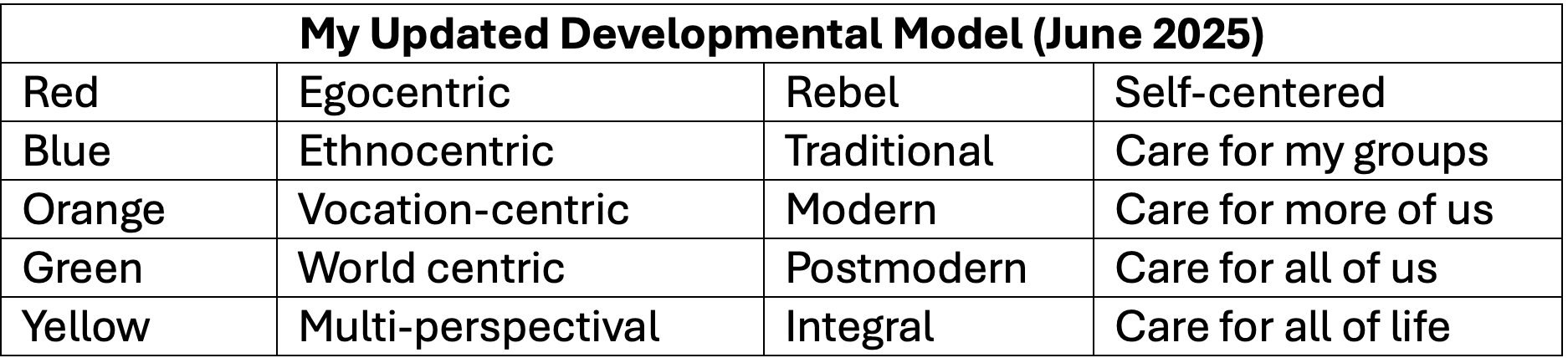
The Five Central Stages of Spiral Dynamics
RED: Power & Impulsivity
Driven by immediate power and dominance
Lives in the present moment, “I want what I want NOW”
Respect comes through strength; might makes right
Breaks free from group control to establish individual autonomy
Avoids guilt about self-interest, survival through dominance
BLUE: Order & Meaning
Life has meaning, purpose, and direction from higher authority
Sacrifice now for reward later; delay gratification
Clear right and wrong; absolute truth exists
Belongs to something larger than self (nation, religion, tradition)
Strong in-group loyalty; “my people” vs. “others”
ORANGE: Achievement & Rationality
Success through strategy, competition, and rational thinking
Progress comes from scientific method and innovation
Individual achievement and merit matter more than birth or tradition
Universal principles apply regardless of group membership
Future-oriented; optimizes and improves systems
GREEN: Equality & Community
All people deserve equal dignity and care
Decisions through consensus; everyone’s voice matters
Aware of systemic oppression and structural inequality
Values diversity, inclusion, and authentic community
Relationships and feelings matter as much as thoughts and achievements
YELLOW: Integration & Systems Thinking
Sees validity in all previous stages; integrates rather than rejects
Thinks in complex systems and contextual situations
Comfortable with paradox; both/and rather than either/or
Functional flexibility; uses appropriate stage for each context
Focuses on what actually works; pragmatic effectiveness
Other
“An Overview of Integral Theory: An All-Inclusive Framework for the 21st Century,” Sean Esborn-Hargens. 2009. I have been looking for a single, best introduction to Integral Theory. This article is the best I’ve found.
The Daily Evolver Podcast, Jeff Salzman. Salzman worked with Wilber for several years and knows the theory in his bones. He is excellent at reviewing culture and current events through the lens of Integral, so he gives us examples of how to process issues with Integral tools. The material on his website is solid. Unfortunately, as of January, 2025, he has not posted new podcasts since March 2024. I hope to see him return someday!
Integrallife.com, this website, which is behind a paywall, provides a wealth of information about Integral, much of it presented in video and audio formats. The teachers and trainers are selected carefully and do a good job of being clear for the beginners among us. Lots of Wilber talks and interviews are included at the site, although a lot can be found on Youtube also.
Deep Transformation Podcast, hosted by Roger Walsh and John Dupuy. They get terrific guests talking about the implications and implementations of Integral Theory. Walsh does a terrific job of periodically summarizing the guest’s comments, often making them clearer. This is the first of 3 episodes interviewing Brad Reynolds who has worked with Wilber and written the most complete review of his work. Brad’s book about Wilber is Where’s Wilber At?
Gary Larson cartoon: https://bit.ly/3uddoUD
Integral Christianity: The Spirit’s Call to Evolve, by Paul Smith. This is a clearly written account of how Integral Theory can be applied to Christianity. It is a “grown-up” account of what Christianity could look like if it was allowed to evolve naturally. 2012.
Stages of Faith: The Psychology of Human Development and the Quest for Meaning, by James Fowler. He was a Harvard professor who created a faith development model that followed the moral development research of Lawrence Kohlberg and Carol Gilligan, in methodology but focused on how people grow in their religious life.
“An Everyone Culture: Becoming a Diliberately Developmental Organization,” Robert Kegan and Lisa Lahey, https://bit.ly/4nxUiDX. Organizations do best when they build an environment that encourages constant personal development among their employees.