
1.1 Buckets or Pathways?
How do we categorize people?
You’ve been talking about Integral Theory. What's that about?
Its become really useful to me since we have become such a polarized and insulated country. Many people on the left and right are incredulous about those at the other end of the spectrum. We can hardly fathom where they are coming from and how angry they seem to be. In turn, we may find ourselves saying and feeling things about others that surprise ourself. When you hear “how can she say that?” the answers set off another round of invective.
Yeah, so how is that related to Integral?
Well, as I began learning about Integral Theory, I realized I was being exposed to a new perspective. I found myself realizing “I know why she says that!” I was reading about human development and I saw that the characteristics for various stages describe many of the public people and personal friends and acquaintances we are referring to when we get angry or troubled or sad about what they say. I began to realize that people were responding based on their stage, and furthermore, I could lower my own blood pressure and reaction based on taking their stage into account.
Human development is described in a number of different theories that focus on different qualities like values, consciousness, spirituality, and care, among others. These different qualities help explain the behavior of people at different stages.
At times I just think the world is going crazy. How does Integral help you understand it?
Well, we are a bit out of control, but developmental theories go a long way toward making sense and providing insight into what is happening. While that is a ways from solutions, I find it reassuring that there is some overarching rationale for our current behaviors.
Can you give me an example?
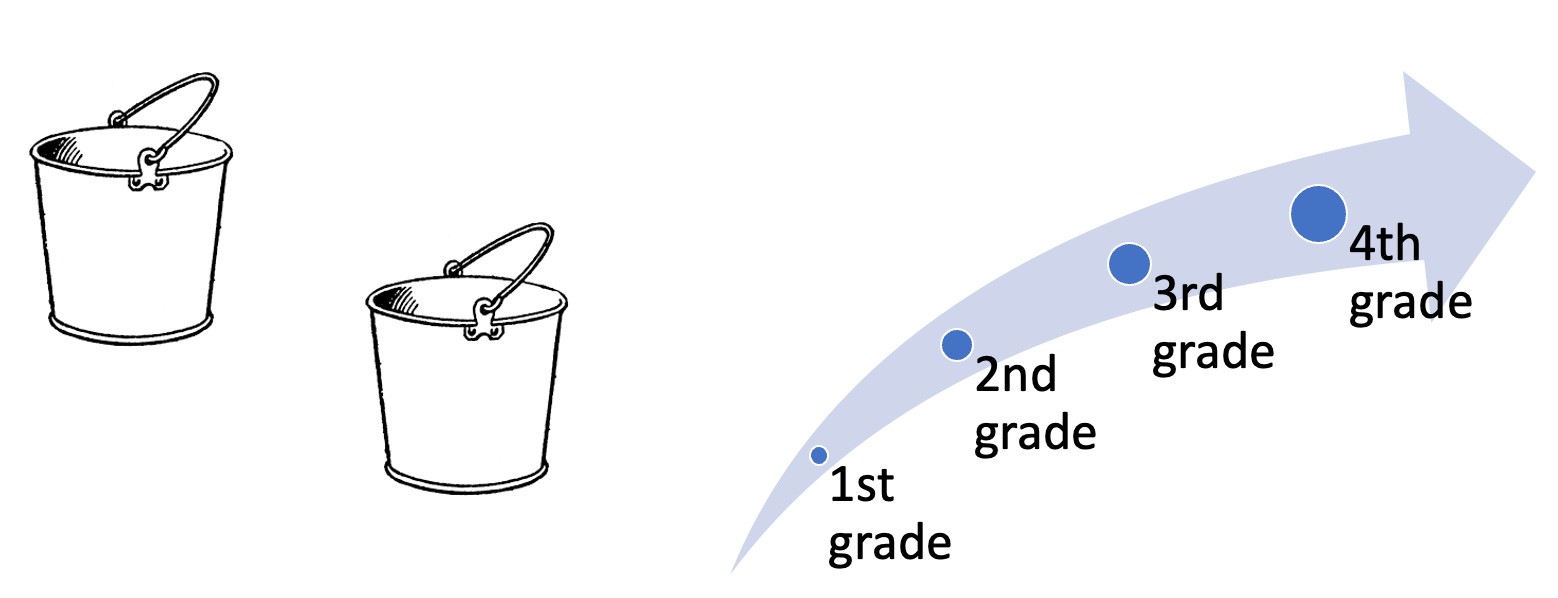
The easiest metaphor I can think to describe my change in perspective is I have let go of my “bucket worldview” and replaced it with a “growth hierarchy.” In my bucket model, I saw people as left or right, red or blue, conservative or liberal, even good or bad. This is a categorizing method of sorting information, types of things or ideas, people, and so on. Using this method I can quickly stereotype them into this or that bucket, which is efficient but leads to several unhelpful downstream effects:
I may think of myself as a liberal or conservative, but in a two bucket model, I can only be one or the other. A liberal with critical thoughts about the liberal project is made to feel unwelcome in the liberal bucket. Conversely, you cannot be a conservative and still agree with liberals on some issues. The requirement for ideological purity has increased dramatically for both ends of the spectrum.
With no middle ground in “Bucket World,” there is little opportunity for collaboration or creativity.
The identity of your bucket, red or blue for example, is important and very potent. Labels become weapons. They keep you in line and they punish your opponent. Changing your mind at a later date is even precarious; your previous identity or opinion can be used to question your credibility and ethics.
Bucket thinkers end up discouraging the very thing they want, new allies and supporters. To join them, your support for the program has to be pure, but you may carry baggage from your previous points of view.
One other thing. The alternative is the Pathway, which is a growth hierarchy. Developmental theories describe the very thing that Bucket thinkers distrust: as we mature, we grow into new worldviews, and that growth translates into changes in our values, politics, religious beliefs, maturity, cognitive development, and so on.
Now I’ve really grown to like the Pathway or growth hierarchy1 worldview because it is based on the theory and research of over 100 developmental models2, it allows for more flexibility, and you can grow to more inclusive, expansive, and more skilled levels. There is a basic rule that governs this model: you have to work your way up the grades (or stages or levels), like a 3rd grader has to complete 3rd grade tasks to get to 4th grade.
In their interactions with the world, the 3rd grader has many ideas and skills, including everything they learned in previous grades. 4th grade material is difficult for 3rd graders so they need to get to 4th grade to master it. In other words, in a growth hierarchy you grow your capabilities to move through the levels.
There are many middle grounds, grey areas, and solutions that do not fit easily into the choices of Bucket World. On the Pathway, you are free to come to your own conclusions based on the reasoning and thinking tools you have learned so far.
Identity is not based on race, gender, or party. It is a fluid, dynamic entity based on those aspects, as well as skills, ideas, tastes, and values. Jazz is not an African American art form; it is music performed by African Americans and people of all races and nationalities.
Changing or refining your position on a topic is up to you. You are free to use your evaluative skills and creativity to develop an infinite variety of novel approaches.
Can you make this more concrete with an example?
Okay, let’s say you have 3 people, Ruby, Bella, and Oliver. They are in a heated discussion about some political issue. Ruby is hyper-vigilant and aggressive and impulsively fights back when she hears something like “no basis in truth.” Bella is polite, but nonetheless firm in her resistance, “Reverend Flynn said just the opposite last Sunday.” And Oliver says, “well, the research has shown that even though this is a common perspective, it’s just not backed by the facts.”
Hmm, I see 3 different buckets. How does that work with your growth hierarchy?
I’ll introduce the idea here and later I will fill in the details of how developmental theories explain differences, differently. Let's say Ruby is in the Red stage, Bella is in the Blue stage, and Oliver is in the Orange stage. These colors do not have any meaning; they are the colors used by the Spiral Dynamics theory of values development and they designate 3 consecutive levels.
Now, just as 3rd graders need to have learned simpler concepts in 3rd grade to get to the 4th grade, people in the Blue stage need to have learned cognitive, social, and psychological skills in the Red stage to form the foundation for Blue. Much like proceeding through school, we proceed through developmental stages by completing pre-requisite skills in the preceding stages. Does that make sense?
So far...
Here are just a few of the traits we can use to describe these three stages:
Red: self-centered, hyper-vigilant, defensive, and impatient
Blue: group-centered people who are more influenced by values, rules, roles, discipline, faith, and order
Orange: individualistic, rational, scientific, and impartial
We naturally prefer the characteristics that describe our stage! But when life conditions change or get more challenging, new skills and values are needed. This can begin a transition from one stage to the next. The driving force to move to the next stage is when the ideas, behaviors and beliefs of a stage don’t work as well for the person. For example, the aggressive behavior of a Red may be getting them into repeated trouble, like an inability to hold onto a job. Learning to follow rules and getting to work on time are some of the "developmental tasks" of maturing to the Blue stage. For some of us, this flows naturally; for others, the lessons take longer to learn. For a few, it never happens.
In this situation, Red Ruby might rebel angrily to the rules, Blue Bella would follow the rules, and Orange Oliver might investigate to see if rules were broken or should be changed. In development theories, stages are laid out in the sequence in which they appear in our lives. In this theory, Red is followed by Blue and Orange, in that order.
Remind me how this is different from camps.
Third and 4th grade are two different stages of awareness, competence, knowledge, and skill. Students don’t pick 3rd or 4th grade based on preference; they graduate based on meeting development requirements. Development, growth, and the motivation for people to transition to the Blue stage, where life is more ordered and secure, does not happen until it becomes more attractive or the rebelliousness of the Red stage becomes too chaotic or exhausting. The Red stage no longer works very well for us when the self-centered way of living in this stage no longer gets us what we want. The reasons for transitioning from one stage to the next will change at different stages, but the common factor is that we outgrow a stage, becoming unhappy and unfulfilled until there is enough motivation to overcome our resistance to change.
I realize the stages can feel like buckets. If we are in Bucket A, we might want to choose Bucket C instead of Bucket B. However, in a Pathway world, we cannot get to C without going through B.
My new developmental worldview reveals that our differences are due much more to the current developmental capabilities of individuals and groups. Where I previously was judgmental, labeling opponents as dumb or immoral, now I see that we have different worldviews based on our respective development. My judgmental attitude disappears! We don't blame 3rd graders for not being 4th graders. We love them. We don't need to blame or shame Reds, although we should still hold them accountable. In the end, we love them to help them let go of defensiveness.
That sounds radical.
It is in the same way Jesus, Mohammed and the Buddha are radical.
Three important points to add here:
Stage is not age-dependent. People in our age group can mature faster or slower than us. Events like marriage, children, education, experience, and career can stimulate maturation or create a crisis if the person is not ready developmentally.
Red, Blue and Orange are just 3 of 8 stages in the Spiral Dynamics3 model. Stay tuned; more to come on this.
I use "stage" and "level" interchangeably, as do most people writing about Integral Theory. (updated 8-6-23)
I will say more about the terms growth hierarchy, power hierarchy, holarchy, and tower of emergence in newsletter 1.12.
Integral Psychology, Ken Wilber, 2000
Spiral Dynamics: Mastering Values, Leadership and Change, Don Beck and Christopher Cowan, 2005.
Thanks Kelly. I'm still learning Substack and just discovered your comment.
One of my quests is how not to get sucked into the fray. Integral is an oasis of steadiness that helps.
You are right that 1st Tier stages do share their holier-than-thou trait with buckets. An insight that improves our understanding.
I learned about Tim Urban from one of Adam Grant's semi-regular lists of book recommendations: https://adamgrant.substack.com/p/the-13-new-books-to-expand-your-mind
Hi Gary! It was so very fortuitous to meet you the other day! I enjoyed the Integral basics laid out in this post, and when the holiday guests depart (love them when they come—love them when they go!) I’ll get to lean-in to all that you offer on your Substack.
I need this!
Thank you for your work!
Wish best wishes…
Peggy M.