
3.9 General Rules about Quadrants
Just as Levels or Stages of Development have rules, these principles create useful mental structures that help us use the Quadrants paradigm of Integral Theory.
(NOTE: If you are new to my site, it helps to read the posts in order. They are listed under the Contents tab here.)
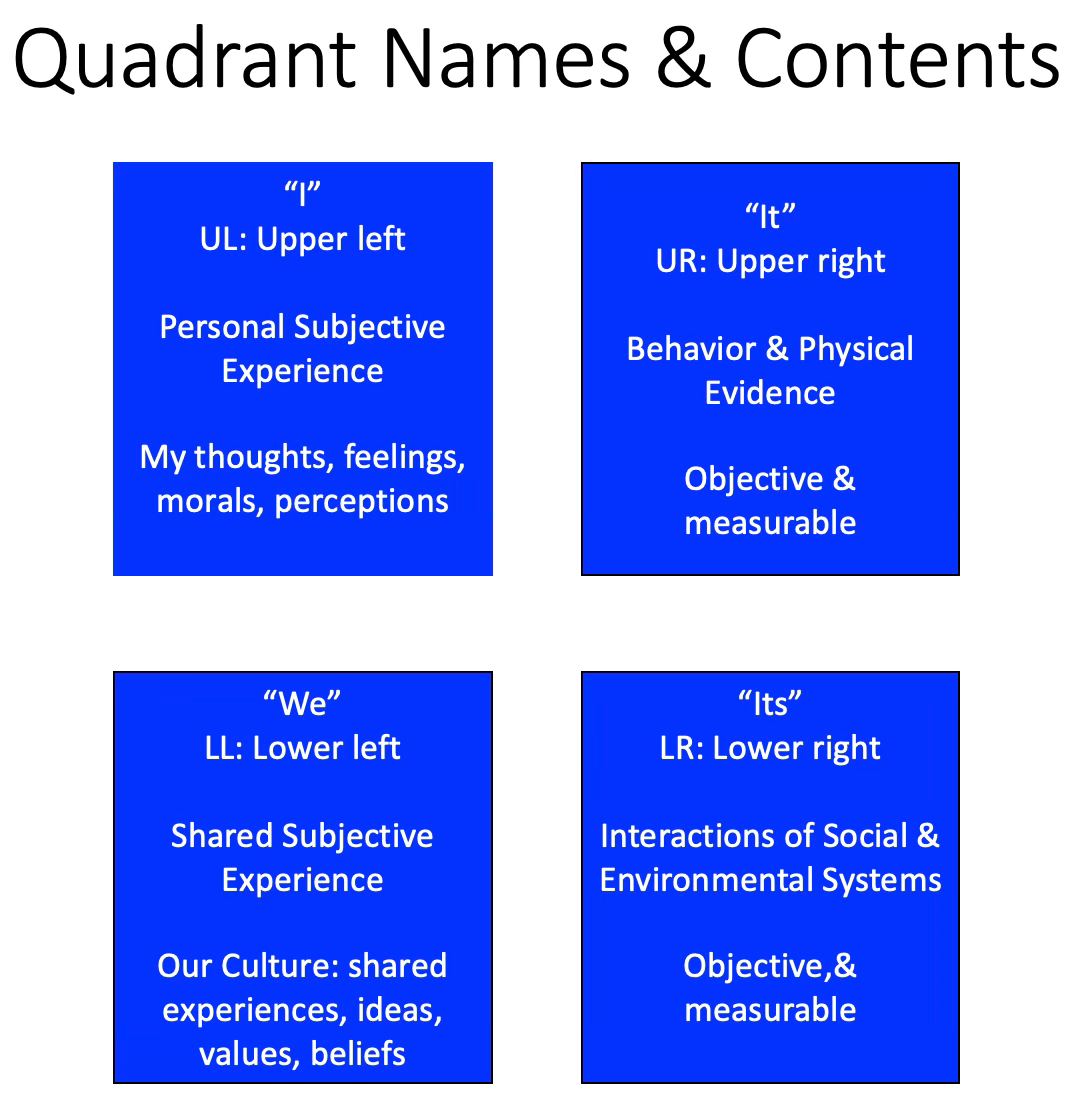
Roger Walsh helps us understand where wisdom is located in the Four Quadrants1. Let’s remind ourselves of what is in each location in the four Quadrants.
Hold on. Wisdom…Location? I’m not following.
Remember, we’ve talked about Maps, which help us locate ideas in the mental environment each of us creates to understand our world. The diagrams, like the one above, that I use in our discussions are maps. Some of us try to be precise about our map, but most of us carry around vague outlines of where ideas belong in relationship to one another.
Walsh’s thoughts about the location of wisdom are captured in the seven rules or principles below. The Rules below are in bold, paraphrased from Walsh. Regular text is my interpretation of Walsh’s rules.
Each one of us has all four domains. We spend time and energy in all four quadrants, thinking with their methods, using their resources, working in their systems, or interacting with others.
Each of us has an interior realm of thought and feeling. The Upper Left. We begin here with subjective insights and understandings. Remember from Post 3.4 that this is the messy realm that does not have concrete methods to guide our decisions, but the post does provide guidelines for deciding and growing from what we learn from the outcomes of our choices.
Each of us has an outer objective realm of the brain and our observable behavior. The Upper Right. This is where we carry out calculations, experiments, verifications, and otherwise confirm the truth about physical reality: action and structure. Post 3.6. Even though the brain is inside us, we study it like an object and use objective tools from an external perspective and use those scientific tools to search for the neural correlates of our internal subjective experiences.
We participate in our culture, comprised of our mutual and subjective experiences, ideas, values, and beliefs. The Lower Left. This quadrant is explained in post 3.5. This is where we talk about and try to make sense of our internal experiences in the context of our family and friends, beliefs, and social norms. We are in a regular “dialogue,” overtly or covertly, with these cultural groupings, trying to balance our internal experiences and socially, culturally, spiritually, and politically acceptable interpretations of those experiences. Does our inner individual reality fit with our internal collective reality?
We participate in collective structures like businesses, economic systems, the legal system, schools, and so on. The Lower Right. Post 3.7. This is where we find the institutions and systems that provide the support and governance of scientific studies and medical practices, the legal systems that resolve conflicts and enforce our cultural values, and the schools that offer training in the objective and subjective methods humans have developed for validity testing. We use similar tools for evaluating systems and institutions in this quadrant. Still, since we are dealing with the interactions of forces and things, the evaluation can be more complicated and considers the suitability of systems, institutions, and processes toward their intended outcomes: does it do what we want it to do?
The characteristics of the four quadrants listed above are interdependent. Each of us shapes and is shaped by the phenomena in all quadrants. Just as we have reason to be concerned that we are not collectively developed enough to solve complex problems, we need to find ways to overcome our slow growth compared to the fast development of complex and wicked issues. Walsh says, “Individuals develop; collectives evolve.” We find exceptional individuals in all fields. We find great teams. We find better-than-average nations. The larger the numbers in a group, the slower the average growth.
The characteristics of the four quadrants are irreducible; you cannot explain phenomena in one quadrant with the terms and tools of the other quadrants. This is one of the brilliant gems of Integral Theory. Wilber has taken the sciences and the insights of wisdom traditions and discovered the four realms they explore and explain. He shows us that we cannot explain our internal insights or emotions with a mechanistic scientific description of the brain’s wiring or chemistry. He shows us that our institutions that guard our freedom of speech do not also explain the joy an immigrant might feel when she realizes she is writing a critical essay with no fear of reprisal. These four realms are interdependent; they overlap and have lots of connective tissue but are four different realms.
“The World’s Great Wisdom: An Integral Overview,” Ch 10, The World’s Great Wisdom: Timeless Teachings from Religions and Philosophies, Ed., Roger Walsh.